
 11
11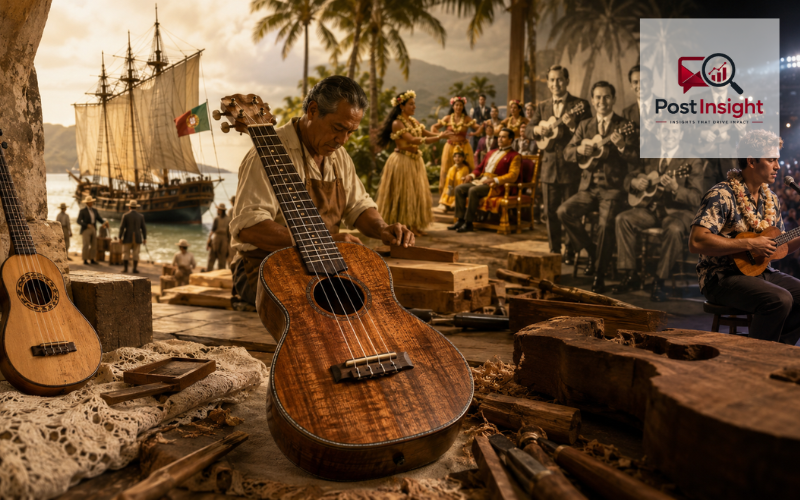
Ukulele history is a story of migration, craftsmanship, Hawaiian culture, and changing musical tastes. Although the instrument is strongly associated with Hawaii today, its roots reach back to small stringed instruments played on the Portuguese island of Madeira.
The modern ukulele began developing in Hawaii during the late 19th century. Portuguese immigrants brought instruments such as the machete and braguinha with them, and Hawaiian musicians and instrument makers gradually adapted these designs. The result was a small four-stringed instrument with a sound and identity that became closely connected with Hawaiian music. The Metropolitan Museum of Art dates one of the oldest surviving Hawaiian ukuleles to about 1880.
Over the following decades, support from Hawaiian royalty helped establish the instrument locally. Hawaiian performers later introduced it to mainland American audiences, where it became a major popular-music instrument during the early 20th century.
Understanding the full history means looking not only at who invented the ukulele, but also at Portuguese immigration, Hawaiian craftsmanship, royal patronage, the 1915 American ukulele boom, and the instrument’s modern revival.
The ukulele did not appear from nowhere. Its closest ancestors came from Madeira, a Portuguese island in the Atlantic Ocean. Musicians there played several small guitar-like instruments, including the machete, braguinha, and rajão.
Historical sources do not always use these names in exactly the same way. The Smithsonian notes that the Hawaiian ukulele developed from Portuguese instruments including the machete, braguinha, rajão, and cavaquinho. These instruments gave early Hawaiian makers a starting point for the size, shape, strings, and playing style of the new instrument.
Portuguese musicians commonly used lively strumming and picking techniques. When these musical traditions reached Hawaii, local listeners encountered a sound that was different from many instruments already familiar to them.
Still, it is important not to describe the ukulele as simply a Portuguese instrument with a Hawaiian name. The Portuguese instruments were its ancestors. The Hawaiian ukulele developed into its own instrument through local craftsmanship, playing styles, materials, and cultural use.
One of the most important dates in the ukulele history timeline is August 23, 1879. On that date, the Ravenscrag arrived in Honolulu after a long voyage from Madeira carrying hundreds of Portuguese immigrants. Many had been recruited to work on Hawaii’s growing sugar plantations.
Among the passengers were Manuel Nunes, Augusto Dias, and José do Espírito Santo, three craftsmen who would become closely connected with early ukulele making. The ship also carried musicians familiar with Madeiran string instruments.
The music quickly attracted attention. Contemporary reports described recently arrived Madeiran musicians entertaining local people with street performances on unfamiliar small stringed instruments. The instruments were portable, lively, and well suited to social music-making.
This meeting of Portuguese musical traditions with Hawaiian culture became the foundation for what eventually developed into the ukulele.
There is no completely accurate answer that names one person as the sole inventor of the ukulele.
Three Madeiran craftsmen are most often associated with its early development: Manuel Nunes, Augusto Dias, and José do Espírito Santo. All three arrived in Hawaii aboard the Ravenscrag in 1879 and later became involved in making stringed instruments in Honolulu. The Metropolitan Museum of Art states that by 1888 all three were producing instruments for the local market.
Historical records also show that Augusto Dias was listed as a guitar and furniture maker in Honolulu in 1884, making him one of the earliest documented professional makers connected with the instrument.
Manuel Nunes later promoted himself as an inventor of the ukulele, but modern historical accounts generally treat the instrument as the result of gradual development rather than a single moment of invention.
So, when people ask who invented the ukulele, the safest answer is that Nunes, Dias, and Espírito Santo were leading early makers, while Hawaiian musicians and culture played an equally important role in turning their work into the instrument known today.
A common question is: what was the ukulele originally called? The answer needs some explanation because the Portuguese predecessor and the Hawaiian instrument were not exactly the same thing.
Before the ukulele developed in Hawaii, Portuguese musicians played small instruments known by names such as machete, machete de braga, and braguinha. Related instruments included the rajão and cavaquinho.
These names describe instruments that influenced the ukulele rather than an earlier name for an identical instrument.
After arriving in Hawaii, craftsmen changed aspects of the instruments and local musicians developed new ways of using them. During this process, the Hawaiian name ʻukulele became established.
Therefore, saying that the ukulele was “originally called the braguinha” is an oversimplification. It is more accurate to say that the braguinha and related Portuguese instruments were important ancestors of the Hawaiian ukulele.
Hawaii did more than adopt a foreign instrument. Hawaiian musicians and local craftsmen helped reshape it into something culturally and musically distinct.
Early builders worked with materials available in the islands. Koa, a tree native to Hawaii, became particularly closely associated with Hawaiian instrument making. Its attractive grain and musical qualities later made it one of the best-known traditional woods for ukuleles. Koa remains strongly connected with Hawaiian ukulele construction today.
The developing ukulele kept the small body and four-string character of its Portuguese relatives but evolved according to Hawaiian musical preferences. Historical instruments also show that there was not one completely fixed design from the beginning.
Different tunings and construction approaches appeared over time. Eventually, the compact four-string design familiar today became standard, while soprano, concert, tenor, and later baritone sizes expanded the instrument family.
This Hawaiian transformation explains why the ukulele should be understood as a Hawaiian instrument with Portuguese roots rather than simply a Portuguese import.
The rise of the ukulele was helped greatly by King David Kalākaua, who ruled the Kingdom of Hawaii from 1874 until 1891.
Kalākaua strongly supported Hawaiian music, dance, and cultural expression. The ukulele found a place in his royal court and was used during gatherings and performances. According to The Metropolitan Museum of Art, his patronage helped connect the instrument with hula and encouraged its adoption in Hawaiian musical life.
Royal support mattered because it gave the relatively new instrument prestige. Instead of remaining only an immigrant instrument played within Portuguese communities, it became part of a wider Hawaiian musical culture.
The ukulele was soon heard alongside singing and hula and became closely associated with Hawaiian identity. This cultural adoption was one of the most important stages in ukulele history.
Without Hawaii’s musicians, craftspeople, and royal support, the small Portuguese-inspired instrument might never have developed into a globally recognized symbol of Hawaiian music.
The origin of the word ukulele has produced several stories, and historians cannot confirm one explanation with complete certainty.
The best-known translation comes from the Hawaiian words ʻuku, meaning “flea,” and lele, meaning “to jump.” This produces the familiar phrase “jumping flea.” One popular explanation says the name described the fast movement of a player’s fingers across the strings and fretboard.
Another story connects the name with Edward Purvis, a musician associated with King Kalākaua’s court whose energetic personality may have inspired the nickname.
Queen Liliʻuokalani offered a different and more poetic interpretation. According to a tradition recorded by ukulele historians and discussed by the Smithsonian, she understood the name as referring to “a gift that came from afar,” connecting the instrument with its journey from Portugal to Hawaii.
Because several explanations survive, it is better to present them as historical traditions rather than claim that one story is proven beyond doubt.
A short ukulele history timeline makes the instrument’s development easier to follow.
| Period | Important development |
| Before 1879 | Small Madeiran instruments such as the machete, braguinha, and rajão provide the musical foundation. |
| August 23, 1879 | The Ravenscrag arrives in Honolulu carrying Portuguese immigrants, musicians, and craftsmen. |
| 1880s | Manuel Nunes, Augusto Dias, and José do Espírito Santo become important early instrument makers in Hawaii. |
| Late 1800s | King Kalākaua supports the ukulele, and it becomes increasingly connected with Hawaiian music and hula. |
| 1893 | American audiences encounter Hawaiian ukulele performance at the World’s Columbian Exposition in Chicago. |
| 1915 | Hawaiian performers attract major attention at the Panama-Pacific International Exposition in San Francisco. |
| 1910s–1920s | A nationwide American ukulele craze develops. |
| Late 1940s–1950s | Arthur Godfrey helps create another wave of popularity through radio and television. |
| 1990s | Israel Kamakawiwoʻole helps introduce the sound of the Hawaiian ukulele to a new worldwide audience. |
| 2000s–present | Online video, education, and performers such as Jake Shimabukuro strengthen the modern global revival. |
The Smithsonian notes that Americans had encountered ukulele playing before 1915, including at the 1893 Chicago exposition, but the San Francisco exposition became a much larger turning point.
Ukulele history in America began before the famous 1915 boom. Hawaiian performers had already appeared at mainland exhibitions and toured outside the islands.
The major breakthrough came at the Panama-Pacific International Exposition, held in San Francisco in 1915. Hawaii had its own pavilion, where visitors could hear Hawaiian musicians perform. The Smithsonian reports that the pavilion became extremely popular, sometimes attracting tens of thousands of visitors in a single day.
At a time before radio was common in American homes, major public exhibitions provided an important way to discover unfamiliar music. Visitors heard Hawaiian songs and instruments in person and carried that interest back to communities across the country.
The popularity of Hawaiian-themed songs, live performances, sheet music, and touring musicians soon created strong demand for ukuleles.
This was the moment when an instrument already important in Hawaii became a national American popular-culture phenomenon.
During the late 1910s and especially the 1920s, the ukulele became one of America’s fashionable musical instruments.
It suited the entertainment culture of the period. The instrument was small enough to carry almost anywhere, easier for beginners to approach than many larger stringed instruments, and useful for accompanying popular songs. It appeared in vaudeville, social gatherings, recordings, and home music-making.
American manufacturers responded quickly. C. F. Martin & Co., already famous for guitars, began successful ukulele production in 1915 and introduced a dedicated ukulele catalog in 1917. Between 1916 and 1926, Martin produced nearly 57,000 ukuleles, far more than the number of guitars it made during the same period.
Demand peaked for Martin during the mid-1920s. The company’s history records more than 14,000 ukulele orders in 1925 alone.
By this point, the ukulele was no longer viewed only as an instrument for Hawaiian music. Americans were using it to accompany a wide range of popular songs, helping make it one of the recognizable sounds of the era.
Ukulele popularity changed after the Jazz Age, but the instrument never disappeared.
A major revival arrived during the late 1940s and 1950s through radio and television personality Arthur Godfrey. Godfrey regularly played the instrument for large national audiences. The Smithsonian credits him with popularizing the baritone ukulele, while Martin’s records show that its ukulele sales increased sharply during this period.
The instrument remained visible in popular entertainment. Marilyn Monroe’s character Sugar Kane, for example, was a singer and ukulele player in Billy Wilder’s 1959 film Some Like It Hot.
Its mainstream popularity later declined as rock music and electric guitars became dominant, but Hawaii continued to maintain a strong ukulele tradition.
A major modern turning point came through Hawaiian musician Israel Kamakawiwoʻole. His ukulele-led medley of “Over the Rainbow” and “What a Wonderful World,” included on the 1993 album Facing Future, later reached listeners around the world through recordings, films, television, and other media.
In the internet era, Honolulu-born Jake Shimabukuro demonstrated another side of the instrument. His performance of “While My Guitar Gently Weeps” became widely shared online and helped introduce international audiences to the ukulele’s ability to handle complex rock, jazz, classical, and other styles. He remains an active international performer today.
For anyone looking for ukulele history for kids, the basic story is simple. People from Madeira brought small Portuguese stringed instruments to Hawaii in 1879. Hawaiian musicians loved the sound, and local craftsmen helped change the instruments into what became the ukulele. Hawaiian royalty supported it, and musicians later carried its sound around the world.
One of the most interesting ukulele facts is that there was probably no single inventor. Manuel Nunes, Augusto Dias, and José do Espírito Santo all played important roles, while Hawaiian players helped shape how the instrument sounded and how it was used.
Another useful fact is that the ukulele was popular in the United States long before modern internet videos. It experienced major American waves of popularity in the 1910s and 1920s and again during the radio and television era of the 1950s.
Its name also has more than one possible origin story. “Jumping flea” is the best-known explanation, but other interpretations have been recorded.
Readers checking quick-reference sources such as ukulele history Wikipedia pages may see slightly different dates, passenger totals, instrument names, or invention claims. That does not always mean one account is completely wrong. Early ukulele history contains changing terminology and several traditions, so museum collections and historical research are useful for understanding the differences.
The story of ukulele history begins with Portuguese musical traditions but becomes distinctly Hawaiian after 1879. Instruments brought from Madeira provided the foundation, while craftsmen such as Manuel Nunes, Augusto Dias, and José do Espírito Santo helped develop new forms in Hawaii.
Hawaiian musicians then made the instrument their own. King Kalākaua’s support helped connect it with royal performances, hula, and Hawaiian cultural life. By the early 20th century, Hawaiian performers were taking that sound to mainland America, where the 1915 Panama-Pacific International Exposition helped trigger a nationwide craze.
The ukulele continued to move through periods of rising and falling popularity, from the Jazz Age and Arthur Godfrey’s television era to Israel Kamakawiwoʻole and Jake Shimabukuro.
More than a century after its development, the ukulele remains a living instrument rather than simply a historical object. Its continuing popularity reflects the same qualities that helped it spread in the first place: a portable design, an inviting sound, and a musical identity shaped by the meeting of Portuguese roots and Hawaiian creativity.
No single person can be called its definite inventor. Manuel Nunes, Augusto Dias, and José do Espírito Santo were important early makers who helped develop Portuguese-inspired instruments into the Hawaiian ukulele.
The modern ukulele originated in Hawaii during the late 19th century. However, its design was strongly influenced by small Portuguese instruments brought by immigrants from Madeira in 1879.
The ukulele was influenced by Portuguese instruments known as the machete, braguinha, and related forms. These were predecessors rather than simply earlier names for the exact Hawaiian ukulele.
What does the word ukulele mean?
The best-known interpretation is “jumping flea,” possibly describing quick finger movements while playing. Another traditional explanation associated with Queen Liliʻuokalani describes it as a “gift that came from afar.”
The ukulele gained major American attention after Hawaiian musicians performed at the 1915 Panama-Pacific International Exposition in San Francisco. Its popularity grew rapidly during the 1910s and 1920s.
Disclaimer: Historical accounts of the ukulele sometimes differ on exact names, dates, and origin stories. This article uses widely accepted museum, historical, and music-reference information for educational purposes.