
 11
11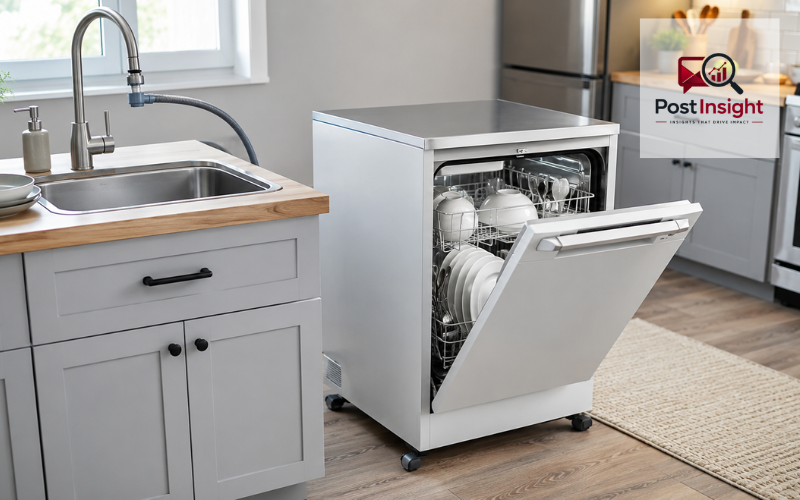
A portable dishwasher is a standalone appliance that washes dishes like a built-in dishwasher but does not require a permanent connection to the home’s water and drain lines. Most models use a hose that attaches to the kitchen faucet and sends wastewater into the sink. Some compact countertop units include a built-in tank that can be filled by hand.
This type of dishwasher is useful when a kitchen has no built-in dishwasher space, permanent plumbing changes are not allowed, or remodeling would cost too much. It can suit apartments, rental homes, older houses, offices, small kitchens, and households that want easier cleanup without altering cabinets.
Portable models are not all equally small. Countertop machines sit on a work surface, while larger units stand on wheels and roll to the sink. Choosing the right portable dishwasher depends on your available space, typical dish load, faucet style, storage area, and budget.
| Feature | Countertop Model | Portable Dishwasher on Wheels |
| Best for | Individuals, couples, offices | Families and frequent cooking |
| Typical capacity | 2–6 place settings | 8–12 place settings |
| Placement | Kitchen countertop | Floor or storage area |
| Water connection | Faucet or built-in tank | Kitchen faucet |
| Common width | About 17–22 inches | About 18–24 inches |
| Storage needs | Limited counter space | Clear floor and rolling space |
| Main advantage | Compact and easy to use | Larger capacity and stronger cleaning |
| Main drawback | Limited space for cookware | Must be moved and connected |
Portable dishwashers generally come in two forms: countertop models and freestanding models on wheels.
A portable dishwasher countertop model sits on a strong, level counter near the sink. It handles smaller loads and is easier to fit into a studio apartment, office kitchen, or home with limited floor space. Some connect to the faucet, while others use a manually filled water tank.
A freestanding portable dishwasher is closer in shape and capacity to a built-in machine. It stands on the floor, commonly measures about 18 or 24 inches wide, and moves on caster wheels. Its hose connects to the sink during a cycle, then stores on or inside the machine afterward.
The choice is mainly about capacity and space. Countertop units use less room but wash fewer dishes. Wheeled models need more storage and movement space but can handle larger household loads.
Countertop dishwashers are designed for small daily loads. Many hold roughly two to six place settings, although rack layout and plate height matter more than the number alone. A machine may hold several standard plates and cups but struggle with large dinner plates, mixing bowls, or pans.
Measure the counter width, depth, and space below wall cabinets before buying. The door opens forward, so leave enough room in front. Check the maximum plate diameter listed by the manufacturer because tall dishes can block the spray arm or stop the door from closing.
Faucet-connected models usually include a hose and quick-connect fitting. Tank-fed models provide more placement flexibility because water is poured into an internal reservoir, but the drain hose still needs a safe outlet, normally the sink.
A countertop portable dishwasher is often best for one or two people, office mugs and lunch dishes, or kitchens where a floor unit would be hard to store. It may be too limited for families that cook often or regularly wash large cookware.
A portable dishwasher on wheels provides more capacity without needing a permanent cabinet opening. It can be stored beside a counter or against a wall and rolled to the sink when needed. Many models have a finished top that can offer temporary workspace when the machine is not running, subject to the manufacturer’s care and weight guidance.
Common widths are around 18 inches and 24 inches. A narrower model may suit a small household or tight kitchen, while a 24-inch machine usually offers fuller capacity. Measure depth, handle projection, turning room, and the path to the sink—not just width.
The appliance must remain close enough to the faucet and a grounded outlet for its original hose and power cord to reach safely. GE states that hoses on some portable models extend about 35 inches and the power cord about five feet, but measurements vary, so the model manual should be treated as the final guide. advantage is larger load space. The main drawback is having to move, connect, disconnect, and store the machine, especially in a crowded kitchen.
A portable dishwasher full-size model can provide washing space similar to a standard built-in unit. It may include two racks, a cutlery basket, several wash settings, and room for a normal family load. Current 24-inch portable models are also available with stainless-steel interiors and high-temperature or sanitizing options. GE, for example, continues to provide support information for its 24-inch GPT225SSLSS portable model, although product availability can change. ize portable dishwasher freestanding model makes sense when a household creates too many dishes for a countertop unit but cannot install a built-in appliance. It can also work as a temporary choice before a kitchen renovation.
Measure the storage location, doorway width, route to the sink, and space needed to open the door. Make sure it will not block drawers, the refrigerator, or a main walkway. Larger capacity is helpful only when moving the appliance remains practical.
Most faucet-connected units use a quick-connect assembly that carries clean water into the dishwasher and sends used water back to the sink. The faucet aerator is removed, an approved adapter is installed if needed, and the connector snaps into place. GE says its adapter fits standard spouts with internal or external threads, while Whirlpool notes that an additional adapter may be needed for some internally threaded faucets. drain must stay open and clear throughout the cycle. Never place a stopper in it, and avoid bending or trapping the drain hose.
Compatibility should be checked before purchase. Pull-down, pull-out, waterfall, square, filtered, and some touchless faucets may not accept a standard adapter. A removable threaded aerator is normally the easiest setup. Faucets with side sprayers need extra caution because manufacturers warn that continuous pressure during a dishwasher cycle can damage the spray hose and cause leaks. orce an adapter or create an improvised connection. Compare the faucet threads with the appliance manual or ask the manufacturer which approved fitting is required.
Measure both the storage position and the place where the dishwasher will operate. For a countertop unit, record width, depth, vertical cabinet clearance, and space for the open door. For a wheeled unit, measure floor space, the route to the sink, and the distance to the outlet and faucet.
Capacity labels are useful, but rack design is equally important. A small machine may handle plates, cups, bowls, and cutlery but leave little room for cookware. A larger model can hold more varied items, yet oversized trays, wooden utensils, cast iron, and delicate pieces may still require hand washing.
Choose according to your actual routine. One person who cooks every meal may create more dishes than a family that often eats away from home. Aim for enough space to clean a normal day’s dishes without packing items so tightly that they block water spray.
Leave any ventilation clearance required by the manual, and make sure hoses and cords cannot be pinched, crushed, or caught under wheels.
Water and energy use vary by model, selected cycle, soil level, water temperature, and drying method. Compact units often use less water per cycle because they wash fewer dishes, but they may need to run more frequently. Larger machines consume more per cycle but clean a bigger load.
The EnergyGuide label and manufacturer specifications provide a better comparison than broad marketing claims. ENERGY STAR’s current product finder shows that certified compact dishwashers differ in annual energy use, water use, capacity, tub construction, and drying system. Listed examples use around 1.6 to 2.0 gallons on the tested cycle, but that range does not apply to every portable dishwasher. Department of Energy states that an ENERGY STAR certified dishwasher uses about 12 percent less energy and 30 percent less water on average than a standard model. ENERGY STAR also highlights soil sensors, efficient spray jets, improved filtration, and better rack design as features that can reduce waste while supporting cleaning performance. ol running costs, wash full but not overcrowded loads, choose the appropriate cycle, avoid unnecessary pre-rinsing, and use air-dry or eco settings when they meet your needs.
A good portable dishwasher can clean everyday dishes effectively, but results depend on loading, detergent, water temperature, spray coverage, and cycle choice.
Normal or auto cycles suit mixed daily loads. Heavy or intensive programs handle dried food and cookware. Rapid cycles work for lightly soiled items but may provide weaker drying. Eco programs often reduce water or energy use by running longer. Delicate settings provide gentler treatment for suitable glasses and dishes.
Make sure each spray arm can rotate freely before starting. Point dirty surfaces toward the spray and tilt bowls so they do not collect water. Remove bones, seeds, labels, and large food pieces, but do not rinse every dish under running water unless the manual recommends it.
Clean the filter regularly. A blocked filter can leave particles on dishes, create odors, and slow drainage. Use only automatic dishwasher detergent because hand-washing liquid can produce excessive foam and leaks. Hard water, incorrect detergent amounts, or poor loading may cause cloudy glassware and residue.
Portable dishwasher tubs may be plastic, stainless steel, or a combination of both. Stainless steel usually resists stains and odors well and retains heat that can support drying. Plastic may reduce the purchase price and will not rust, though it can remain wetter after a cycle. Tub material alone does not decide cleaning quality.
Basic drying systems rely on stored heat and natural evaporation. Other models use heated drying, fans, automatic door opening, or fresh-air ventilation. Active systems may leave fewer droplets but can add cost or use more energy. Plastic containers often remain wet because they do not hold heat like glass, ceramic, or metal.
Useful options include adjustable racks, delayed start, child lock, soil sensors, extra-dry settings, status lights, and high-temperature cycles. When a product advertises sanitizing, check the manual for the required cycle and whether the claim is tested to a recognized standard. Choose features that improve your normal routine rather than paying for programs you are unlikely to use.
Portable dishwasher installation is usually simple, but the owner’s manual should guide every step. Place the appliance on a stable, level surface. Confirm that the sink drains freely, the hose is not twisted, and the faucet connection is secure. Use the grounded outlet specified by the manufacturer and avoid extension cords.
For a faucet-fed model, run the hot water until it reaches the temperature recommended in the manual, turn it off, and attach the connector. Check for drips before starting. Whirlpool’s installation guidance identifies adapter setup, hose connection, and leak testing as key parts of the process. hes without nesting them, add the correct amount of automatic detergent, and select a suitable cycle. Do not disconnect the hose until the program has ended and pressure has been released as directed.
Afterward, let hot dishes cool, drain the connector into the sink, return the hose to storage, and wipe away moisture. Latch the door before moving a wheeled model. Tank-fed units should be emptied or dried according to the manual when they will not be used for several days.
Routine care keeps a portable dishwasher cleaner and more reliable. Rinse the filter at the interval stated in the manual, inspect spray-arm holes, wipe the door seal, and clean the faucet connector. When permitted, leave the door slightly open after use so moisture can escape.
Leaks may come from a loose adapter, worn washer, damaged hose, poor leveling, or too much foam. Stop the machine and turn off the faucet if water escapes. Poor drainage can result from a blocked sink, clogged filter, bent hose, or interrupted cycle. Odors usually improve after trapped food is removed and a manufacturer-approved cleaning cycle is run.
Wet dishes do not always mean the appliance is faulty. The cycle may use passive drying, plastic items may hold droplets, or the door may have been opened too soon. Rinse aid can help when the model supports it.
Hard water can leave scale and reduce spray performance. Use the recommended detergent amount and an approved descaling method. Never mix cleaning chemicals inside the dishwasher.
The best portable dishwasher is the model that fits your kitchen, connects safely, holds your normal load, and can be stored without becoming a daily obstacle.
A small countertop model may suit one person, a couple, or light office use. An 18-inch or 24-inch freestanding model is more practical for families, frequent cooks, and people who want to wash larger plates and cookware.
When comparing a portable dishwasher nearby, examine the rack spacing, door movement, wheels, controls, hose storage, and connector. For a portable dishwasher on Amazon or another marketplace, confirm the exact model number and seller, then compare the listing with the manufacturer’s official specifications and warranty.
Professional tests can reveal differences in cleaning, drying, noise, and ease of use. Portable dishwasher Reddit discussions and customer reviews can reveal repeated owner concerns, but they should not replace verified specifications. Look for patterns, check review dates, and make sure comments refer to the same model.
Before ordering, confirm dimensions, faucet compatibility, electrical needs, return policy, warranty, replacement-part access, noise rating, capacity, drying method, and tested energy and water use.
A portable dishwasher can add automatic cleaning to a kitchen that cannot support a permanent built-in appliance. Countertop units save space and suit smaller loads, while portable dishwashers on wheels provide greater capacity and may perform much like full-size built-in machines.
Begin with accurate measurements and a careful faucet check. Confirm that the appliance fits its storage and operating positions and that the supplied connector can attach safely. Then compare rack space, wash cycles, drying method, water and energy information, maintenance needs, noise, and warranty support.
For renters, apartment residents, small households, or homeowners postponing a remodel, the right portable dishwasher can reduce daily cleanup without permanent plumbing work. It is most useful when its size, connection method, and capacity match the way your household actually uses the kitchen.
Not every faucet is compatible. Most models require a removable threaded aerator. Pull-down, pull-out, filtered, square, or touchless faucets may need a special adapter or may not work safely.
No. Most portable dishwashers temporarily connect to the kitchen faucet and drain into the sink. Countertop models with water tanks can be filled manually without using a faucet connection.
Many freestanding portable dishwashers provide cleaning performance similar to built-in machines. Countertop models also clean well, but their smaller racks may not hold large pans or full family loads.
Space depends on the model. Measure the appliance’s width, height, depth, open-door clearance, hose reach, and storage path before buying to ensure it fits comfortably near your sink.
No. Regular hand-washing soap creates too many suds and may cause leaks. Always use detergent specifically made for automatic dishwashers and follow the recommended amount in the appliance manual.
Disclaimer: This article provides general information only. Product features, prices, availability, faucet compatibility, and installation requirements may vary. Always check the manufacturer’s specifications and instruction manual before purchasing or using an appliance.