
 11
11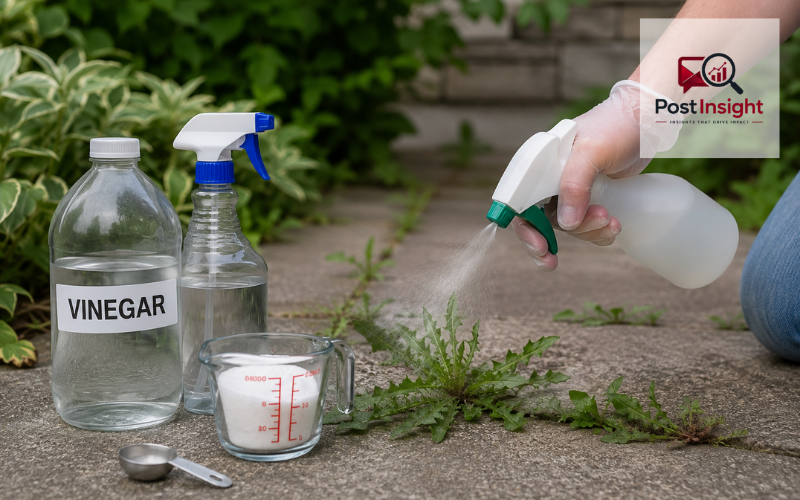
Vinegar weed killer is popular because it is easy to find, simple to apply, and often makes small weeds wilt quickly. Its active part is acetic acid, which damages the green tissue it touches. This makes vinegar a non-selective contact weed killer: it can burn weeds, but it can also injure grass, flowers, vegetables, and other plants if the spray lands on them.
The main limitation is that vinegar usually affects the leaves and stems rather than moving through the whole plant. Young annual weeds may die after one careful treatment, but established weeds can grow back because their roots remain alive.
This guide explains how vinegar works, which strength to choose, a practical vinegar weed killer recipe, safe mixing ratios, suitable application areas, and the precautions needed when using stronger products. University extension guidance confirms that acetic-acid contact treatments work best on young annual weeds and are less reliable against roots, underground stems, and other established root systems.
| Vinegar type | Acetic acid strength | Best use | Important limitation |
| Household white vinegar | About 5% | Young weeds in patio or driveway cracks | Often fails to kill established roots |
| Horticultural vinegar | About 20% | Tougher weeds in approved hardscape areas | Can cause serious skin and eye injuries |
| Concentrated vinegar | About 30% | Only where permitted by the product label | Requires strict safety precautions |
| Vinegar with dish soap | 5% vinegar plus a small amount of soap | Helps the spray coat waxy leaves | Remains non-selective |
| Vinegar with salt | Vinegar plus optional salt | Permanent weed-free cracks or gravel areas | Salt can damage soil for a long time |
The acetic acid in vinegar removes moisture from exposed plant cells and damages their protective outer layer. The treated leaves may lose color, curl, turn brown, or collapse. With small weeds, these changes can appear within hours, especially during warm, dry weather.
This is different from a systemic herbicide. A systemic product is absorbed and moved through the plant, sometimes reaching the roots. A contact product mainly harms the part that receives the spray.
For this reason, vinegar weed killer gives the best results when weeds are young, tender, and actively growing. Mature weeds with thick leaves, deep taproots, bulbs, or underground stems are much more likely to return.
Standard household white vinegar normally contains about 5% acetic acid. It may be enough for tiny seedlings and soft annual weeds growing in pavement cracks. It is less dependable on large weeds, waxy leaves, or plants that have been established for a long time.
Horticultural vinegar commonly contains about 20% acetic acid, while some concentrated products reach 30%. A 20% solution is four times as concentrated as ordinary 5% kitchen vinegar. That does not simply mean it is four times better. It also brings a much greater risk of skin irritation, eye injury, breathing discomfort, and damage to nearby plants or surfaces.
For household vinegar, a carefully targeted homemade mixture may be reasonable for a small hardscape problem. For 20% or 30% vinegar, use a product specifically labeled for weed control and follow its directions exactly. Do not invent a dilution rate or transfer the product into an unmarked container.
For young weeds in driveway joints, patio gaps, or sidewalk cracks, a simple household mixture is usually enough to test whether vinegar will work for the problem.
Use:
Pour the vinegar into a clearly labeled garden sprayer, add the dish soap, and mix gently to avoid creating excess foam. Salt is optional and should usually be left out. It may make foliage dry faster, but it can move into nearby soil and make future plant growth difficult.
This recipe is intended for ordinary 5% vinegar, not concentrated horticultural vinegar. Never add other household chemicals, especially bleach or ammonia. A similar one-gallon vinegar, soap, and salt mixture is described in Lowe’s organic lawn-care guidance, along with a warning that it can damage both weeds and desirable plants.
The basic vinegar weed killer ratio for household use is one gallon of 5% white vinegar to one tablespoon of liquid dish soap. Salt is not required. When it is used for a permanent weed-free crack or gravel area, one cup per gallon is a common amount, but the risk to soil should be considered first.
For a smaller 32-ounce spray bottle, use one quart of 5% white vinegar and about three-quarters of a teaspoon of dish soap. The matching optional salt amount would be one-quarter cup. Leave enough space in the bottle to mix the liquid safely.
Do not use these ratios for vinegar weed killer 30% products. Concentrated solutions may have their own application rate, equipment requirements, protective clothing instructions, and restrictions.
Stronger is not automatically more effective, particularly when the roots are the main reason a weed keeps returning. The product label should decide how a commercial concentrate is mixed and used.
Dish soap is included in many homemade recipes because it helps the vinegar spread across the leaf instead of forming beads and rolling away. Only a small quantity is needed. Adding more soap does not make the treatment more selective and may increase the chance of harming nearby plants.
Salt works differently. It draws moisture from plant tissue and may make the top growth dry more quickly. However, salt does not disappear as quickly as vinegar. Repeated use can allow it to build up in soil or wash toward lawn edges and planting beds. It can then interfere with water uptake and damage plants that were never meant to be treated.
For cracks surrounded by concrete, a small amount may be acceptable if runoff is controlled. Near a garden, lawn, tree, hedge, or future planting area, the safer choice is to leave salt out and deal with regrowth by pulling or repeat spot treatment.
Start with a clean sprayer that has not held an incompatible chemical. Label it clearly and use it only for weed treatment. Adjust the nozzle to produce a narrow, controlled spray rather than a wide mist.
Aim directly at the weed and wet the upper and lower leaf surfaces evenly. The leaves should be well covered, but the mixture should not run across the pavement or flow into nearby soil. A piece of cardboard can serve as a simple shield between the weed and a desirable plant.
Because vinegar weed killer is non-selective, accuracy matters more than covering a large area quickly. Avoid spraying above ankle height where mist can travel onto flowers or shrubs. Keep children and pets away during mixing and application, and follow any re-entry direction stated on a commercial product’s label.
Choose a calm, dry day when rain is not expected soon. Wind can carry droplets onto useful plants, while rain can wash the vinegar from the leaves before it has enough contact time. Warm weather and direct sun often make visible drying happen faster, but extreme heat can also increase drift and damage to nearby plants.
Treat weeds when they are small and actively growing. A tiny seedling has fewer stored resources than a mature dandelion, so it is easier to control. Check the area after several days rather than assuming the brown leaves mean the entire plant is dead.
When fresh growth appears, either spray the new leaves again or remove the plant by hand. Frequent regrowth is a sign that vinegar is only suppressing the top and that digging, hoeing, mulching, or another suitable control method may provide a better long-term result.
The most suitable locations are places where no wanted plant should be growing. Examples include driveway seams, patio joints, paver gaps, gravel paths, sidewalk cracks, parking areas, and open fence lines away from ornamental plants.
Hardscape areas make targeted application easier and reduce the chance of spraying a crop or lawn. Even there, watch where the liquid drains. A crack may connect directly to soil containing grass roots, tree roots, or flower-bed plants.
Before treating decorative stone, painted material, metal edging, or a sealed surface, check the product label and test a hidden spot. Concentrated acetic acid can be harsh on more than plant tissue. Commercial 20% vinegar weed killers are marketed for non-selective control, and current product information emphasizes preventing overspray onto desirable vegetation.
Vinegar is a poor choice for broadcast spraying over a lawn because it cannot tell the difference between a weed and grass. A direct hit can brown or kill both. Spot spraying is still risky when weeds are tightly mixed with turf.
Avoid routine use in vegetable beds, flower borders, ground-cover areas, and around the base of trees or shrubs. The spray can contact wanted leaves, and runoff may reach shallow roots. Salt-containing recipes create an additional soil concern.
Do not spray near ponds, drains, streams, or other water. Some registered acetic-acid herbicide labels warn of hazards to fish and aquatic invertebrates. Also avoid applying a homemade mixture to a place where local rules require a registered and labeled pesticide product.
Perennial weeds survive from one year to the next by storing energy below ground. Dandelions use deep taproots. Thistles may spread through roots or underground stems. Other difficult weeds survive through rhizomes, bulbs, or tubers.
When vinegar burns the leaves, the underground system can use stored energy to produce a new shoot. Repeatedly removing fresh growth may slowly weaken some plants, but it can take several treatments and may still fail if the root system is large.
For one or two weeds, loosen damp soil and remove as much of the root as possible. For spreading weeds, combine careful pulling with mulch, edging, or repeated shallow cultivation. Vinegar can be one part of control, but it should not be expected to solve every perennial weed problem by itself.
Vinegar weed killer 30% and 20% horticultural products should be treated as strong acids, not as ordinary cooking ingredients. Wear the exact protective equipment stated on the label. This often includes chemical-resistant gloves, eye protection, long sleeves, long pants, closed shoes, and sometimes additional protection.
Mix or pour concentrated vinegar outdoors or in a well-ventilated place. Keep your face away from the opening, avoid breathing the mist, and never use food containers for measuring or storage. Keep the original label attached and store the product upright, away from children, pets, heat, and food.
Acetic acid exposure can irritate the eyes, skin, nose, and throat, and concentrated contact can cause burns. If it reaches the eyes, begin rinsing with plenty of water and follow the first-aid directions on the product label. Seek medical help as directed. NIOSH lists eye and skin burns among the possible effects of acetic acid exposure.
The best vinegar weed killer is not simply the bottle with the highest percentage. Begin with the weed, location, and level of control needed. A ready-to-use spray is convenient for a few cracks and reduces mixing. A concentrate may cover more ground, but it creates more handling risk and requires accurate label-based preparation.
Check whether the product is actually labeled as a weed or grass killer. A bottle sold as “30% cleaning vinegar” is not automatically the same as a registered herbicide with weed-control directions. Read the active ingredient percentage, approved use sites, target weeds, protective-equipment section, coverage estimate, rain guidance, storage instructions, and retreatment limits.
Also examine the sprayer. A narrow trigger suits individual weeds, while a wand may reduce bending on a larger paved area. Terms such as “natural” or “organic” do not remove the need for protective equipment. EPA guidance states that pesticide labels define where, how, how much, and how often a product may legally be used.
As of July 2026, shoppers searching for vinegar weed killer at Home Depot can find labeled 20% acetic-acid weed-control products, including options sold in smaller bottles and one-gallon sizes. Home Depot also publishes guidance explaining that vinegar is non-systemic and may require the dead plant to be removed to prevent regrowth.
A search for vinegar weed killer at Lowe’s may show ready-to-use weed and grass killers as well as concentrated vinegar sold primarily as a cleaner. These products should not be treated as interchangeable. Choose one whose label clearly permits the intended outdoor weed-control use.
Vinegar weed killer on Amazon includes ready-to-use salt-and-vinegar formulas and other acetic-acid products, although brands, sellers, and stock can change. Review the full label rather than relying only on the product title or customer comments.
For a “vinegar weed killer near me” search, use local store inventory tools and confirm the concentration and use directions before traveling. Avoid buying a damaged, leaking, unsealed, or poorly labeled container.
Vinegar weed killer can be useful for young weeds growing in driveway cracks, patio joints, and other hardscape areas. A mixture of 5% white vinegar and a small amount of dish soap is simple to prepare, while salt should be reserved for places where soil damage will not create a future problem.
Its limits are just as important as its benefits. Vinegar is non-selective, usually acts on visible growth, and may need to be applied again when perennial roots survive. Pulling, digging, mulching, or using a properly labeled alternative may work better when weeds are mature or growing among wanted plants.
Use the lowest suitable strength, spray only the unwanted foliage, prevent drift and runoff, and treat 20% or 30% products with serious care. Protecting useful plants, soil, people, pets, surfaces, and nearby water is the best way to make vinegar-based weed control practical and responsible.
Vinegar may permanently kill small annual weeds, but established perennial weeds often regrow. It burns the visible leaves while taproots, bulbs, or underground stems may remain alive.
A common household ratio is one gallon of 5% white vinegar mixed with one tablespoon of liquid dish soap. Salt is optional and should be avoided near soil used for growing plants.
Young weeds may begin wilting or turning brown within a few hours during warm, sunny weather. Complete drying may take one or more days, depending on the plant and vinegar strength.
Vinegar should not be sprayed broadly across a lawn because it is non-selective. It can damage grass just as easily as weeds, leaving brown or bare patches.
Thirty-percent vinegar is much stronger than kitchen vinegar and can cause severe eye or skin injuries. Use only a properly labeled product while wearing the recommended protective equipment.
Disclaimer: This information is for general educational purposes. Always read and follow the product label, wear suitable protection, and check local rules before applying vinegar or any weed-control product.


