 11
11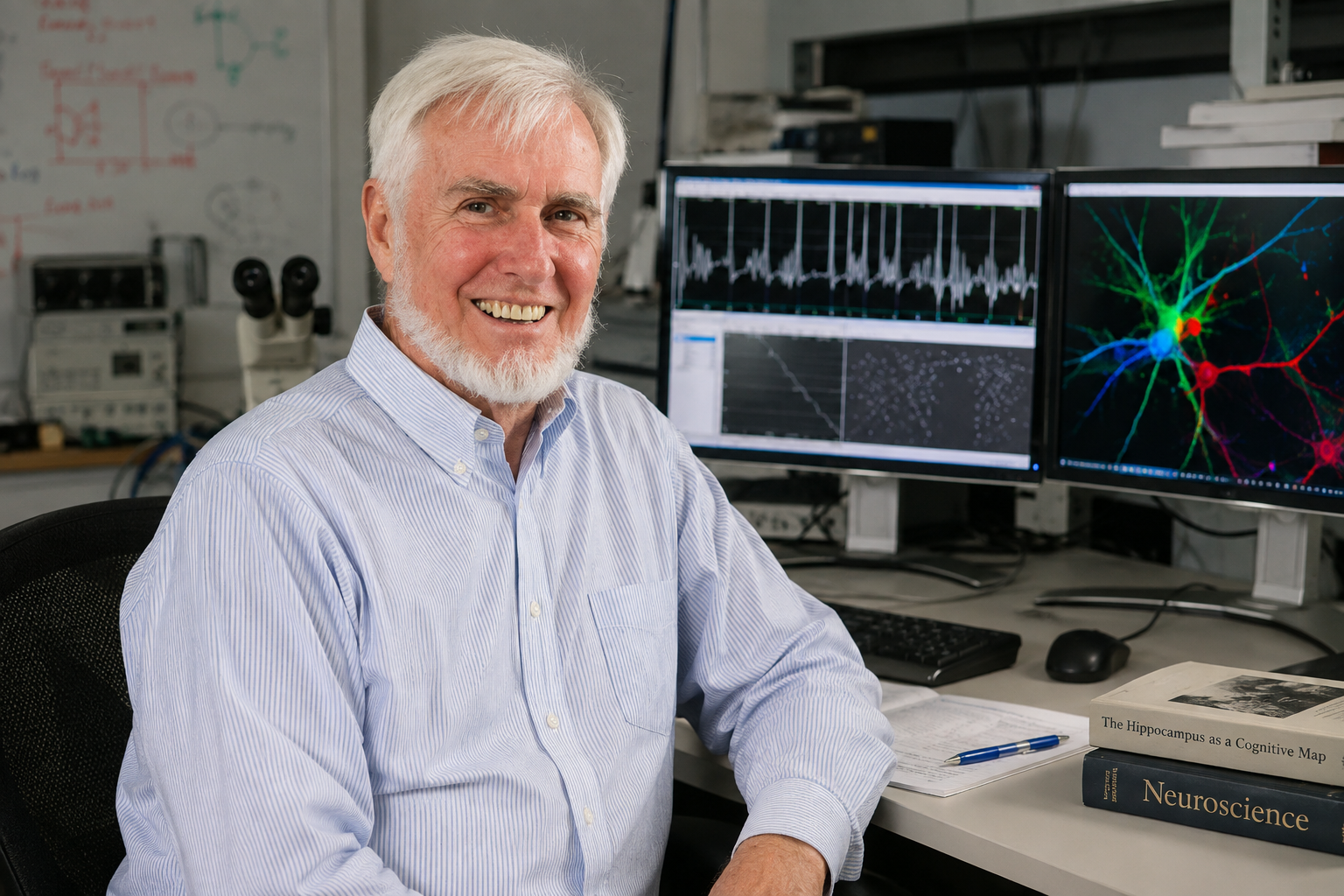
Professor John O’Keefe is an American-British neuroscientist and psychologist whose research changed the way scientists understand how the brain represents location and helps us navigate the world. Born in New York in 1939, he has spent most of his scientific career at University College London (UCL), where his work has focused heavily on the hippocampus, a brain region closely linked with memory and navigation.
O’Keefe is best known for discovering place cells, special brain cells that become active when an animal is in a particular location. This finding provided important evidence that the brain creates an internal representation of the surrounding environment. His work eventually became part of what is often described as the brain’s internal positioning or navigation system.
In 2014, John O’Keefe received one-half of the Nobel Prize in Physiology or Medicine. May-Britt Moser and Edvard I. Moser jointly received the other half for related discoveries involving the brain’s navigation system.
Readers searching for John O’Keefe Boston police obituary should note that this refers to a different person. John J. O’Keefe III was a Boston police officer who died in Massachusetts in January 2022 and is not connected with Professor John O’Keefe, the neuroscientist.
| Detail | Information |
| Full Name | John Michael O’Keefe |
| Date of Birth | November 18, 1939 |
| Birthplace | New York City, United States; he was born in Harlem and grew up in the South Bronx. |
| Nationality/Citizenship | American-British; Nobel records state that he holds both U.S. and British citizenship. |
| Profession | Neuroscientist, psychologist, researcher and Professor of Cognitive Neuroscience at University College London. |
| Short Biography | O’Keefe studied psychology at City College of New York, earned his PhD at McGill University in 1967, and moved to UCL. His discovery of hippocampal place cells transformed research into spatial memory and navigation. |
| Known For | Discovering place cells and helping establish the cognitive-map theory of how the brain represents location. |
| Major Award | Received half of the 2014 Nobel Prize in Physiology or Medicine; May-Britt Moser and Edvard Moser jointly received the other half. |
| Family | Born to Irish immigrant parents. He met his wife, Eileen, while studying at City College of New York. They had one son after moving to Britain and later adopted a second son. |
| Net Worth | Not publicly verified. I found no reliable authoritative source documenting Professor John O’Keefe’s personal net worth, so giving a dollar estimate would be speculative. |
John Michael O’Keefe was born on November 18, 1939, in New York City. His parents were Irish immigrants, and he grew up in Harlem and the South Bronx. He later obtained British citizenship as well as retaining his American citizenship.
His academic path gradually moved toward psychology and the study of the brain. He completed doctoral training at McGill University in Montreal, Canada, receiving a PhD in physiological psychology in 1967. Physiological psychology examines how activity in the brain and nervous system relates to behaviour and mental processes.
After completing his doctorate, O’Keefe moved to England for postdoctoral research at University College London. That move became a major turning point in his career because he remained closely associated with UCL for decades. In 1987, he was appointed Professor of Cognitive Neuroscience at the university.
His early research interests increasingly centered on the hippocampus and the question of how individual brain cells could contribute to memory, behaviour and a sense of location.
The connection between John O’Keefe and UCL has lasted for most of his scientific career. UCL’s current academic profile identifies him as Professor of Cognitive Neuroscience, while the Sainsbury Wellcome Centre lists him as leader of the O’Keefe Lab.
O’Keefe was also the inaugural Director of the Sainsbury Wellcome Centre for Neural Circuits and Behaviour, a neuroscience research centre at UCL. However, an important detail is sometimes missed in older biographies. He did not remain director permanently. UCL announced in 2015 that he would step down from the directorship in September 2016 so that he could concentrate more fully on scientific research.
As of 2026, the Sainsbury Wellcome Centre identifies Tom Mrsic-Flogel as its Director, while O’Keefe remains Professor of Cognitive Neuroscience and continues to lead his research group.
This distinction is useful because some older Nobel and institutional pages still reflect O’Keefe’s earlier role as director.
One of the most important moments in John O’Keefe’s neuroscience career came from experiments involving freely moving rats. Instead of studying only the general activity of large brain regions, O’Keefe and neuroscientist Jonathan Dostrovsky recorded the electrical activity of individual neurons in the hippocampus while rats moved through an environment.
They noticed something remarkable. Certain hippocampal neurons became especially active when a rat entered one particular area. Another neuron might respond strongly somewhere else. The activity therefore appeared to contain information about the animal’s location.
O’Keefe and Dostrovsky published these observations in 1971 in their landmark paper, The Hippocampus as a Spatial Map: Preliminary Evidence from Unit Activity in the Freely-Moving Rat.
The discovery was important because it suggested that hippocampal neurons were not simply responding to isolated sights or movements. Their activity appeared to represent where an animal was within its surroundings.
That idea opened a new way of studying how physical activity in individual brain cells could support a complex mental ability such as navigation.
John O’Keefe’s place cells can be understood as brain cells that are strongly associated with particular locations.
Imagine a rat exploring a room. One place cell may become most active when the rat is near one corner. Another may become active near the center. The area where a particular place cell shows strong activity is commonly called its place field.
No single cell needs to represent an entire room. Instead, the activity of many place cells can work together to provide information about where the animal is. The Royal Society describes O’Keefe’s discovery as showing that individual cells respond to an animal’s physical position and collectively contribute to a cognitive map.
Place cells should not be confused with grid cells. Grid cells were discovered later in the entorhinal cortex by researchers including May-Britt Moser and Edvard Moser. A place cell tends to be strongly associated with a particular area, while a grid cell becomes active at multiple locations arranged in a repeating spatial pattern.
Both types of cells contribute to our scientific understanding of spatial navigation, but they perform different roles.
The discovery of place cells led O’Keefe toward a broader idea: the cognitive map.
A cognitive map is an internal representation of an environment. Rather than remembering only a series of movements such as “turn left, then right,” an animal may have a more flexible representation of where places are located in relation to one another.
O’Keefe proposed that the hippocampus plays a major role in creating this type of representation. When different combinations of place cells are active, their patterns can help represent different positions within an environment. The theory was developed further by O’Keefe and Lynn Nadel in their influential 1978 book The Hippocampus as a Cognitive Map.
This research connected the activity of individual neurons with higher-level abilities such as spatial memory and navigation.
The popular phrase “inner GPS” is useful for explaining the idea, but the brain is more complicated than an electronic GPS device. O’Keefe’s work describes biological systems that use memory, sensory information and patterns of neural activity to help represent location and guide behaviour.
O’Keefe’s research did not stop at discovering where place cells become active. He also investigated when they fire.
The hippocampus produces rhythmic patterns of electrical activity. One important pattern is known as the theta rhythm, which is especially prominent in rodents during active movement.
In 1993, John O’Keefe and Michael Recce reported an important relationship between theta activity and place-cell firing. As an animal moved through a cell’s place field, the timing of the cell’s firing shifted progressively relative to the ongoing theta rhythm. The phenomenon became known as theta phase precession.
In simple terms, the brain may encode spatial information through both the location in which a neuron fires and the precise timing of that activity.
This discovery added another level to the understanding of the hippocampus. Spatial coding was not simply about which cells were active. The timing of their activity could also carry useful information.
Theta phase precession has since become an important subject in research examining how the hippocampus represents sequences, movement, navigation and memory.
The John O’Keefe Nobel Prize recognition came in 2014 after more than four decades of research that began with his discovery of place cells.
The Nobel Assembly awarded one-half of the 2014 Nobel Prize in Physiology or Medicine to John O’Keefe. The remaining half was awarded jointly to May-Britt Moser and Edvard I. Moser. The official reason was their discoveries of cells that form a positioning system in the brain.
O’Keefe’s part of the achievement centered on his discovery that particular hippocampal cells were associated with specific locations. The Mosers later discovered grid cells and helped reveal another important part of the brain’s spatial system.
The Nobel Prize recognized how these discoveries provided a cellular explanation for an important cognitive ability: knowing where we are and navigating through an environment.
The award also showed the long-term importance of O’Keefe’s original research. An observation made in experiments during the early 1970s ultimately helped establish an entire field devoted to understanding the neural basis of spatial representation.
O’Keefe’s place cells and the grid cells associated with the work of May-Britt Moser and Edvard Moser are closely related, but they are not the same.
Place cells are found mainly in the hippocampus and become strongly active when an animal occupies a particular area. Grid cells are found mainly in the entorhinal cortex and fire at multiple positions that form a repeating, grid-like pattern across an environment.
The Nobel Committee viewed these discoveries together because they revealed complementary parts of the brain’s positioning system. O’Keefe’s research showed that individual neurons could represent specific places, while the Mosers’ work helped explain how the brain may organize spatial coordinates and movement across an environment.
Scientists continue to investigate exactly how these systems interact. Current research does not treat the brain as a simple GPS receiver. Instead, navigation appears to involve several connected brain regions and different types of spatially responsive cells.
Together, however, place cells and grid cells provide one of neuroscience’s clearest examples of how patterns of neural activity can represent information about the outside world.
The importance of John O’Keefe’s neuroscience research reaches beyond simply understanding how animals find their way around a room.
His experiments helped scientists connect the firing of individual neurons with complex behaviour. This was significant because functions such as memory and navigation had previously been difficult to explain at the level of individual brain cells.
Place-cell research has influenced studies of spatial memory, learning, environmental recognition and the wider function of the hippocampus. It has also encouraged researchers to explore how the brain represents relationships between locations, events and experiences.
O’Keefe’s research remains active. The current O’Keefe Lab at the Sainsbury Wellcome Centre studies how the entorhinal cortex and hippocampus contribute to spatial memory. The group also investigates mechanisms involved in shorter-term forms of memory in the amygdala. Its research uses modern recording and imaging technologies to examine brain-cell activity during behaviour.
The lab’s more recent listed publications show that O’Keefe’s work has continued well beyond his Nobel-winning discoveries, including research on how hippocampal place cells represent goals during navigation.
O’Keefe’s work also has relevance to research on Alzheimer’s disease because some of the brain areas involved in navigation and memory are affected during the disease.
The hippocampus and entorhinal cortex play important roles in remembering places and navigating an environment. Difficulties with orientation and spatial navigation can therefore provide useful clues about changes affecting these brain systems.
Recent research continues to investigate this connection. A 2025 study involving people with amnestic mild cognitive impairment found that poorer spatial navigation was associated with Alzheimer’s-related pathology and changes in brain regions involved in navigation. The researchers suggested that navigation assessment may have value when studying early Alzheimer’s-related changes.
However, this point needs careful wording. John O’Keefe’s place-cell research is not itself an established diagnostic test for Alzheimer’s disease. His discoveries provide an important scientific foundation for understanding brain systems involved in orientation and memory.
Researchers are still studying whether specific navigation tasks can become useful additions to existing approaches for detecting or monitoring cognitive decline.
People searching for John O’Keefe books are most likely to encounter The Hippocampus as a Cognitive Map, written with psychologist and neuroscientist Lynn Nadel and originally published in 1978 by Oxford University Press. UCL now hosts information about an openly available version of the book.
The book developed the argument that the hippocampus supports an internal representation of space. It became an important part of the scientific discussion surrounding cognitive maps, spatial memory and hippocampal function.
O’Keefe’s earlier 1971 paper with Jonathan Dostrovsky provided the experimental foundation for the place-cell idea.
Another landmark publication came in 1993, when O’Keefe and Michael Recce published their research on the relationship between hippocampal place cells and theta rhythm, laying out the phenomenon now known as theta phase precession.
His later publications have continued to explore the spatial system. The current O’Keefe Lab page highlights work on environmental geometry, cognitive maps, spatial navigation and goal-oriented activity in hippocampal place cells.
Readers searching for John O’Keefe Google Scholar or John O’Keefe UCL h-index should be careful when comparing numbers from different academic databases.
An h-index measures a combination of publication output and citations, but the result can vary depending on which database is being used. Google Scholar, Scopus, Web of Science and other services may include different sets of papers and citations, so there is no single permanent number that should be quoted without identifying the source and date.
For a reliable institutional overview of O’Keefe’s research, UCL maintains an official academic profile and publication record.
His recognition extends far beyond citation statistics. O’Keefe was elected a Fellow of the Royal Society in 1992 and is listed as FMedSci FRS by the Royal Society.
In 2014, he also shared the Kavli Prize in Neuroscience with Brenda Milner and Marcus E. Raichle. The award recognized their discoveries of specialized brain networks involved in memory and cognition.
These honors reflect the wider scientific importance of O’Keefe’s contribution to understanding memory, navigation and brain function.
Professor John O’Keefe changed modern neuroscience by showing that the brain contains cells whose activity is closely linked with an individual’s position in an environment. His discovery of place cells provided a new way to understand how the hippocampus supports spatial representation and navigation.
His later work on cognitive maps and theta phase precession showed that the brain’s spatial system involves both patterns of activity across different neurons and the timing of their firing.
The importance of these discoveries was recognized internationally when O’Keefe received half of the 2014 Nobel Prize in Physiology or Medicine, with May-Britt Moser and Edvard Moser sharing the other half for related discoveries involving the brain’s positioning system.
More than five decades after the first place-cell paper, the questions raised by Professor John O’Keefe remain central to neuroscience. Researchers continue to investigate how the hippocampus and connected brain regions create spatial memories, guide navigation and contribute to broader forms of memory.
His work did more than identify an unusual type of neuron. It helped demonstrate how the activity of individual brain cells can contribute to complex mental abilities, making place-cell research a lasting foundation for the scientific study of memory and navigation.
Professor John O’Keefe is an American-British neuroscientist at UCL whose research on hippocampal place cells transformed scientific understanding of spatial memory, navigation and the brain’s internal positioning system.
O’Keefe received half of the 2014 Nobel Prize in Physiology or Medicine for discovering place cells, which helped reveal how the brain represents location and supports navigation.
Place cells are neurons in the hippocampus that become active when an animal occupies particular locations, allowing groups of cells to help create an internal representation of its surroundings.
O’Keefe’s autobiographical account identifies his wife as Eileen, whom he met during an advanced philosophy course at City College of New York. They later raised two sons.
Professor John O’Keefe’s net worth has not been reliably disclosed by authoritative public sources. Any precise figures published on unofficial biography or celebrity-finance websites should therefore be treated cautiously.
Disclaimer: This information is provided for educational and biographical purposes using reputable public sources. Personal and financial details may not be publicly disclosed; therefore, no unverified net-worth estimate has been presented.