
 11
11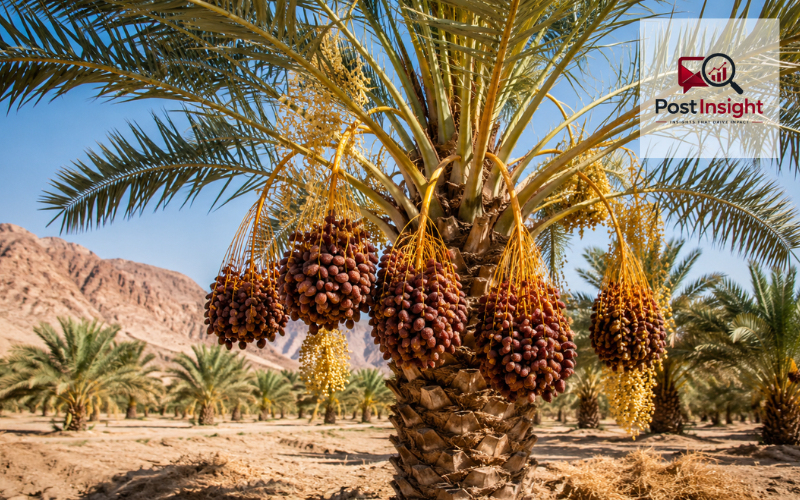
The date fruit palm is a tall evergreen tree that produces dates, the naturally sweet fruits eaten fresh or dried. Its botanical name is Phoenix dactylifera, and it belongs to the palm family, Arecaceae. A mature tree has an upright trunk, a crown of feather-like fronds, and heavy fruit clusters below the leaves. It can live for more than 100 years, although harvesting becomes harder as the palm grows taller.
A true fruit-producing date palm is different from many palms planted only for decoration. Some ornamental palms are separate species, such as the Canary Island date palm, while others may be male date palms that never carry a crop. A female Phoenix dactylifera needs suitable pollen, enough heat, careful watering, and a long dry ripening season to produce good-quality dates. This combination makes the date fruit palm both a landscape tree and an important food crop in warm, dry regions.
| Feature | Quick Information |
| Botanical name | Phoenix dactylifera |
| Plant type | Evergreen fruit-producing palm |
| Typical height | Around 15–30 metres |
| Best climate | Hot, dry, and sunny |
| Pollination | Male and female trees are separate |
| Time to fruit | Usually 4–10 years, depending on propagation |
| Popular varieties | Medjool, Deglet Noor, Barhi, and Zahidi |
| Fruit stages | Hababouk, Kimri, Khalal, Rutab, and Tamar |
| Water needs | Deep and regular watering |
| Common uses | Fresh fruit, dried dates, syrup, paste, crafts, and animal feed |
The exact starting point of date palm domestication is debated because people have moved and cultivated the tree for thousands of years. It was grown in ancient Mesopotamia by about 4000 BC. Botanical records place its native range from the Arabian Peninsula to southern Pakistan, while cultivation spread it across North Africa, the Mediterranean, and other warm regions.
The tree became especially valuable in desert and oasis communities. It supplied concentrated food, shade, useful plant material, and income in places where many fruit crops struggled. Its tall crown also helped create cooler growing spaces beneath it, allowing farmers in traditional oasis systems to grow smaller trees and crops below. For this reason, the date fruit palm is closely connected with the agricultural history and culture of dry regions.
A mature date palm usually has one straight trunk marked by old leaf bases. Depending on age, variety, and conditions, it may reach roughly 15 to 30 metres or more. Its crown carries long, arching fronds, and the lower part of each frond may have sharp spines. The roots spread widely and may also grow deep.
Flowers appear in branching clusters below the crown. After pollination, female clusters develop into large hanging bunches containing many single-seeded fruits. Young palms look compact and leafy because their trunks are not yet clear. Mature fruit palms are taller and may carry supported or covered bunches. Ornamental palms may look similar but may belong to another species or may not be selected for reliable fruit quality.
Date palm flowers form inside a firm covering called a spathe. As the flowers mature, the spathe splits and reveals many small flowers arranged along slender branches. Date palms are dioecious, meaning male and female flowers normally grow on separate trees. Male clusters produce pollen, while female clusters contain the flowers that can become dates.
Wind can carry pollen, but commercial growers usually pollinate by hand. They may tie pieces of a male flower strand into the female cluster or collect, dry, and apply pollen with hand tools or mechanical dusters. This improves fruit set and allows a small number of male palms to serve many female trees.
Successful pollination is essential because an unpollinated female flower will not develop into a normal marketable date. Timing also matters, so growers inspect newly opened spathes and may pollinate more than once when flowering is uneven.
It is difficult to identify the sex of a young date palm by its leaves, trunk, or general shape. A seed-grown plant may be male or female, and its sex usually becomes clear only when flowering begins. This uncertainty is one reason orchards use named female offshoots or tissue-cultured plants rather than random seedlings.
Once flowers appear, the difference is easier to see. Male spathes are generally shorter and wider, and their flower clusters are more tightly crowded. When opened or shaken, the flowers release pale, powdery pollen. Female clusters are less densely packed, and the individual flowers show more yellow colouring. Their role is to receive pollen and form fruit, while male palms provide the pollen needed for fertilisation.
Date fruit passes through five recognised stages. Hababouk begins soon after fertilisation, when the fruit is tiny. During Kimri, it is green, firm, moist, and increasing in size. At Khalal, it reaches full size and turns its variety-specific colour, often yellow or red. It remains crisp, and cultivars such as Barhi are prized at this stage.
Rutab begins when the fruit softens and browns, often starting at one end. Moisture falls, sweetness becomes stronger, and the flesh becomes tender. Tamar is the fully ripe stage, when the fruit has lost more water and has a soft, semi-dry, or dry texture depending on the cultivar. Dates may be marketed at Khalal, Rutab, or Tamar, so “ripe” does not mean exactly the same thing for every variety.
Growers judge harvest readiness by colour, softness, moisture, and the intended market. Because fruits on the same bunch may ripen at different times, some varieties require several picking rounds.
Medjool is a large, soft date with rich, caramel-like sweetness and is commonly eaten whole. Deglet Noor is usually smaller, lighter, and firmer, with a delicate sweetness and semi-dry texture suited to eating, cooking, and processing.
Barhi is small and round. It is unusual because many people enjoy it at the yellow Khalal stage, when it is crisp and sweet with a flavour often compared with brown sugar. As it moves into Rutab, it becomes softer and darker. Zahidi is generally a firmer, semi-dry date with a mild, nutty sweetness and good storage qualities.
Other important cultivars include Ajwa, Sukkari, Khalas, Halawy, and Khadrawy. Each one has its own colour, moisture level, texture, flavour, and regional importance.
Dates are often grouped as soft, semi-dry, or dry, but climate and harvest stage can change their final texture. The best cultivar depends on local conditions, market demand, and whether the fruit will be eaten fresh or processed.
A date fruit palm performs best outdoors in a hot, sunny, arid or semi-arid climate. It needs a long warm season to develop and ripen its crop, along with low humidity and little rain as the fruit approaches maturity. The tree can tolerate extreme heat when it has enough water, but young palms and some cultivars may be damaged by hard frost.
Choose a site with full sun, good air movement, deep soil, and room for the crown and roots. A fruiting orchard also needs female palms of known cultivars and access to compatible pollen. An isolated female may flower without producing a useful crop.
Container growing is possible while a palm is young, but long-term fruit production in a pot is difficult because the tree needs extensive root space, steady moisture, and strong heat. In humid, rainy, or cool-summer regions, it may survive as an ornamental yet fail to ripen high-quality fruit.
Date palms can grow in sandy, loamy, or moderately heavy soils if drainage is suitable. They tolerate some salinity better than many fruit trees, but they are not true salt-loving plants and generally perform better in less salty soil and water. Waterlogged ground can reduce root health, especially where the soil stays cold or poorly aerated.
Although the tree is drought-tolerant, fruit production requires dependable irrigation. Young palms need regular water while establishing, and mature trees need deep watering rather than shallow splashes. The schedule depends on heat, soil, rainfall, and tree size.
The well-known description that a date palm likes its “feet in water and head in fire” reflects its needs: available moisture around the roots, strong sun, and dry heat around the crown and ripening fruit. Rain or high humidity late in the season can encourage splitting, fermentation, mould, or fruit rot.
The answer depends greatly on how the palm was produced. A seed may germinate readily, but a seed-grown date palm is genetically different from its parent. About half of seedlings may be male, and even a female seedling may produce fruit with unexpected size, taste, or texture. Seedlings can take many years to reveal their sex and may require up to about ten years to produce their first crop.
Offshoots develop from the base of a mature palm. Because they are clones, a female offshoot keeps the fruit traits of its mother tree. Established offshoots may begin bearing in about four to five years, although full commercial yields take longer. Tissue culture also produces many plants of a known cultivar.
Heat, watering, soil fertility, planting quality, pollination, and cultivar all influence the timeline. Early flowering is not the same as full production; crops generally become larger and more dependable as the palm matures.
Fruit bunches can become large and heavy. Growers may thin young fruits, tie the strands, and support the stalk to prevent breakage. Mesh or paper covers can protect ripening dates from birds, insects, dust, and light rain while allowing ventilation.
Harvest timing depends on the cultivar and desired product. Crisp Barhi may be cut at Khalal, while soft dates may be picked during Rutab and semi-dry varieties closer to Tamar. Workers may remove individual ripe fruits over several visits or cut the entire bunch when maturity is even. Tall palms require trained workers, secure ladders, or lifting equipment.
Fresh Khalal and Rutab dates are more perishable and should be cooled promptly. Soft or high-moisture dates benefit from refrigeration, while drier Tamar dates keep longer when protected from heat and moisture. Freezing in a moisture-proof container can preserve quality for extended storage. Fruit showing mould, fermentation, or an unusual smell should be discarded.
Dates provide concentrated energy because much of their carbohydrate is present as natural sugar. They also contain dietary fibre, minerals such as potassium and magnesium, and a range of plant compounds. Nutrient levels vary by cultivar and ripeness. Dates can be part of a balanced diet, but their sweetness and energy density make portion size important, especially for people who monitor carbohydrate intake.
Current research describes promising antioxidant and other biological properties, but laboratory findings should not be turned into claims that dates prevent or cure disease. Their clearest everyday value is as a convenient source of energy and fibre that can add sweetness and flavour to food.
The tree itself provides shade, helps support oasis farming, and remains economically important to growers and rural communities. Its ability to produce food under intense heat gives it special value in dry-land agriculture, provided enough water is managed responsibly.
The term “date palm juice” can describe more than one product. Date fruit juice is made by softening dates in water and separating the liquid. When filtered and concentrated, it becomes date syrup, also called dibs or rub. Date paste keeps more fruit solids and fibre, while liquid date sugar is more refined.
Palm sap is different. It is a clear liquid collected by cutting or tapping part of the palm, and it contains mainly sucrose. Sap tapping is associated with several palm species and is practised with Phoenix dactylifera in some places, but cutting the growing area can damage or kill the tree when done incorrectly. It should not be confused with juice extracted from date fruits.
Other products include date molasses, vinegar, fermented drinks, seed coffee-style beverages, and date powders. Homemade juice or syrup should use clean fruit, safe water, clean equipment, and suitable heating or refrigeration. Commercial labels should be checked for added sugar and storage directions.
The date fruit palm is much more than a decorative desert tree. Phoenix dactylifera is an ancient food crop with separate male and female plants, managed pollination, and five recognised fruit-development stages. Its success depends on strong sun, long summer heat, deep watering, drainage, and dry conditions during ripening.
Choosing a known cultivar is equally important because Medjool, Deglet Noor, Barhi, Zahidi, and other varieties differ in texture, flavour, harvest stage, and climate needs. With the right environment and patient care, a date palm can provide fruit, shade, useful materials, and long-term value.
No. A date fruit palm is specifically Phoenix dactylifera, which is cultivated for edible dates. Many other palm species are grown mainly for decoration and do not produce useful date crops.
Offshoot-grown palms may begin producing fruit after four to five years. Seed-grown palms often take seven to ten years and may not produce fruit identical to the parent tree.
A female palm needs pollen from a male palm to produce a good date crop. Commercial growers normally use manual pollination to improve fruit quality, size, and yield.
They grow best outdoors in hot, sunny, and dry climates. They may survive in cooler or humid areas, but the fruit may not ripen properly without enough summer heat.
Date palms tolerate drought, but productive trees need deep, regular watering. The soil should remain adequately moist around the roots without staying waterlogged or poorly drained.
Disclaimer: This article provides general educational information about date fruit palms. Growing conditions, fruiting times, and care needs may vary by climate, cultivar, soil, and local agricultural practices.


