
 11
11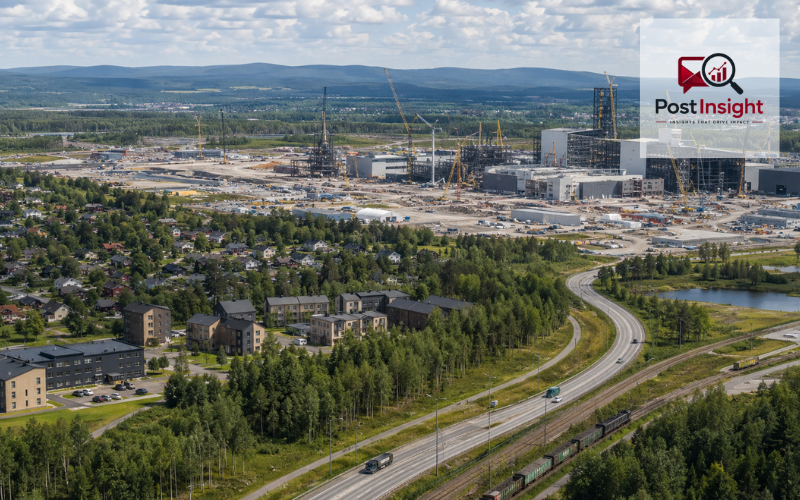
Bodenxt is a development and coordination platform created by the Municipality of Boden in northern Sweden. Its purpose is to help the municipality manage a period of unusually fast industrial and community growth. Boden describes the change as a development leap that would normally take around 20 years but is now happening within only a few years.
Much of this transformation is connected with major green industrial investments in and around Boden Industrial Park. The most visible example is Stegra, the company formerly called H2 Green Steel, which is building a large hydrogen, iron, and steel facility in Boden.
However, Bodenxt is not simply an industrial project. New factories create demand for workers, homes, schools, roads, railways, utilities, local services, and businesses. They also bring new people into the community. Bodenxt provides a way to coordinate these connected changes instead of dealing with each issue separately.
Understanding Bodenxt therefore means looking at the bigger picture: how Boden is trying to combine industrial development with jobs, housing, infrastructure, business opportunities, public services, and a community where people can build long-term lives.
Quick Guide Table
| Area | What Bodenxt Focuses On |
| Skills | Recruiting, training, and supporting workers |
| Housing | New homes, neighborhoods, schools, and services |
| Infrastructure | Roads, railways, water, utilities, and transport |
| Business | Supporting local companies and new investments |
| Sustainability | Industrial symbiosis and smarter resource use |
| Community | Public services, safety, and long-term growth |
Bodenxt is the Municipality of Boden’s strategic structure for managing the wider transformation taking place across the municipality. It brings together several areas of development that need to progress at roughly the same time.
The main work areas include skills supply, living and housing, business development, and infrastructure above and below ground. These areas are closely connected. A company cannot expand without workers, workers need housing and services, new neighborhoods need utilities and transport, and a growing industrial area needs suppliers and reliable infrastructure.
This makes Bodenxt broader than any one company or construction site. It is a municipal approach to planning for the effects of rapid growth across society.
The platform also supports longer-term planning. Boden Municipality is reviewing its wider growth programme and preparing future plans for housing and business expansion as conditions continue to change. In 2026, the municipality began work on an updated growth programme for 2027–2030.
Boden needed Bodenxt because the speed and scale of development created challenges that ordinary planning processes alone could struggle to handle.
A major industrial investment does not affect only the land where a plant is built. It can quickly change demand for housing, skilled workers, roads, wastewater systems, education, public transport, emergency services, restaurants, shops, and many other parts of daily life.
Boden therefore developed a structure that crosses normal administrative boundaries. Different municipal departments and municipal companies can work toward common goals rather than treating housing, infrastructure, workforce needs, and business development as completely separate subjects.
This coordination is important because decisions in one area can directly affect another. Building homes without enough water and transport capacity creates problems. Recruiting thousands of workers without enough housing makes relocation difficult. Developing an industrial park without strong rail connections can limit logistics.
Bodenxt is designed to keep these pieces connected while allowing the municipality to think beyond immediate construction needs.
Stegra is one of the biggest reasons Boden’s transformation has accelerated. The company was originally known as H2 Green Steel and changed its name to Stegra in September 2024. Its large industrial project in Boden combines green hydrogen, iron production, and steelmaking.
The basic idea is to reduce the use of fossil fuels in steel production. In traditional steelmaking, coal and coke are major sources of emissions. Stegra plans to use hydrogen produced with renewable electricity in an important part of its iron-making process. The company says its steel can be produced with up to 95 percent lower carbon dioxide emissions than conventional steelmaking.
The size of the project has created effects far beyond the industrial site. Workers and contractors need places to live, companies need new transport links, local businesses can gain customers, and public services must prepare for a larger and more international population.
For that reason, Bodenxt should not be confused with Stegra. Stegra is a major industrial company and investment. Bodenxt is the wider municipal framework for managing the social and economic transformation surrounding investments such as Stegra.
One of Bodenxt’s most important functions is coordination.
Boden Municipality works with companies, municipal organizations, public bodies, local businesses, developers, and other stakeholders that are affected by the transformation. The goal is to identify problems early and make sure that different development projects support each other.
The municipality has described Bodenxt as a way of governing that works across administrative boundaries. Coordinators and working groups focus on key development areas while remaining connected to the wider transformation.
This approach is especially important when growth happens quickly. A normal sequence in which infrastructure, housing, services, and jobs develop slowly over many years is harder to follow when major changes occur almost at the same time.
Coordination does not remove every difficulty, but it can make dependencies clearer. It allows decision-makers to see community development as one connected system instead of a collection of isolated projects.
People are central to Bodenxt because new industries cannot operate without enough skilled workers.
Stegra and other employers require people with experience in areas such as industrial operations, engineering, maintenance, logistics, technology, administration, and services. At the same time, a growing population creates more demand for workers in schools, healthcare, shops, restaurants, construction, and public services.
Boden is therefore working on recruitment, education, training, job matching, and ways to make relocation easier. In January 2026, the municipality also announced a new engineering programme connected with future employment needs created by industrial growth and an expanding defence sector.
Attracting a worker is only part of the challenge. Families may move with them, and partners also need employment, social connections, education, and other opportunities. Boden Municipality has developed initiatives for accompanying partners as more people relocate for new jobs.
Successful skills supply therefore depends on whether newcomers can become part of the wider community, not simply fill an available job.
Rapid job creation naturally increases demand for housing. This has made living and housing one of the central parts of Bodenxt.
New employees may need rental apartments, houses, temporary accommodation, or family homes. Construction workers and contractors can have different needs from people planning to settle permanently. The municipality must therefore consider several types of housing at the same time.
Housing development has already been taking place in different parts of Boden, while the municipality continues to seek conditions for further construction. Previous municipal forecasts have also pointed to significant population growth linked to Stegra and other expanding sectors.
But a successful growing town needs more than buildings. Families consider schools, preschools, transport, recreation, safety, shopping, nature, and community life when deciding whether to stay.
That is why Bodenxt connects housing with the wider living environment. The long-term aim is not simply to accommodate workers temporarily, but to create conditions where new and existing residents can live comfortably as Boden changes.
Large-scale growth puts pressure on infrastructure that people may not always notice until capacity becomes limited.
Above ground, Boden needs roads, rail connections, bridges, streets, public transport, and logistics routes. Below ground, growth affects water supply, wastewater treatment, pipes, electricity systems, communication networks, and other essential infrastructure.
One major milestone came on June 9, 2026, when the new railway connecting Boden Industrial Park was officially inaugurated. The project includes about six kilometres of track and nine bridges and connects the industrial area with the wider railway network.
Wastewater capacity is another example. Boden Municipality has been expanding the Svedjan wastewater treatment plant to support population growth and meet future needs.
These projects show why infrastructure is a core part of Bodenxt. Industrial development can only function over the long term if basic systems grow with it, while residents also need reliable everyday services.
Boden’s transformation creates opportunities beyond the companies making the largest investments.
New industries require contractors, maintenance companies, transport providers, food services, accommodation, construction, consulting, technology, cleaning, security, and many other services. A growing population can also create demand for shops, restaurants, entertainment, personal services, and local entrepreneurship.
Examples of these effects are already visible. In April 2026, Boden Municipality highlighted how local restaurant operations had expanded alongside activity at Boden Industrial Park, creating new business opportunities and employment.
Bodenxt’s business-development work therefore has a wider purpose than attracting another major factory. It also concerns helping existing companies respond to changing demand and making it easier for new businesses to become part of the local economy.
If these effects spread across different sectors, the transformation can create a more diverse business environment rather than an economy dependent on only one industrial investment.
Industrial symbiosis sounds complicated, but the basic idea is simple: something that one business does not need may become useful to another business.
A large industrial site can produce excess heat, material flows, by-products, or other resources. Instead of treating every residual flow as waste, companies can explore whether it can be reused in another process or business.
This thinking is an important part of Boden’s smart-green development ambitions. In March 2026, discussions highlighted opportunities to turn waste heat, residual materials, and industrial by-products into new business ideas and circular systems.
For example, heat that would otherwise be lost might potentially support another activity if the technical and economic conditions are suitable. Materials from one process may also have value elsewhere.
The important point is that industrial symbiosis tries to connect businesses so resources can be used more efficiently. Within Bodenxt, this approach links environmental goals with local business development and innovation.
Factories, roads, and houses are only part of a functioning community. Rapid growth also affects schools, safety services, municipal administration, emergency planning, and other public responsibilities.
Emergency response provides a clear example. As Stegra develops its industrial emergency-response organization, it is working closely with Boden’s municipal rescue services. Training, communication, equipment, risk planning, and joint working methods are being developed to prepare for the requirements of a large industrial facility.
The municipality has explained that Stegra’s own industrial response unit is intended to complement the municipal rescue service. Cooperation is important because an incident at a complex industrial site may require specialized knowledge as well as public emergency resources.
Growth can also affect traffic, education, community safety, and demand for public services.
Bodenxt therefore reflects an important principle: social and public infrastructure must develop alongside industrial infrastructure. A successful industrial expansion still depends on a safe, functional community around it.
The scale of Boden’s transformation also brings real challenges.
One of the hardest tasks is balancing speed with long-term quality. Housing and infrastructure need to be developed quickly, but decisions made under pressure can affect the municipality for decades. Planning therefore has to consider both immediate shortages and future needs.
Skills supply is another challenge. Recruiting people is difficult when many green industrial projects across northern Sweden and other regions are competing for similar expertise.
Housing availability, construction costs, infrastructure investment, municipal finances, environmental considerations, traffic, public services, and changing industrial schedules can all influence progress.
There is also a wider community question. For Bodenxt to support lasting development, the benefits of transformation need to reach more than the largest industrial companies. Existing residents, small businesses, families, public services, and new arrivals all form part of the same community.
The success of Bodenxt will therefore depend not only on how much industry is built, but on how well Boden manages the changes surrounding it.
In 2026, Bodenxt remains part of an active transformation rather than a finished programme with a fixed ending.
A major development came on June 24, 2026, when Stegra announced the closing of a €1.4 billion financing round led by a Wallenberg Investments consortium. Stegra said the funding would support completion of its Boden project. Following slower activity during the financing process, the company also said construction was being ramped up while the overall project timeline remained under review.
Another important milestone came in April 2026. The Swedish Agency for Economic and Regional Growth recognized Stegra’s Boden facility as a Strategic Net-Zero Project. The designation is connected with the EU’s climate and industrial goals and reflects the project’s intended role in reducing industrial emissions and strengthening European clean-technology supply chains.
Meanwhile, Boden’s wider transformation continues. The industrial railway has opened, wastewater infrastructure is being expanded, workforce initiatives are developing, local businesses are adapting, and the municipality is reviewing its future growth strategy.
This means the next phase of Bodenxt will continue to depend on what happens both inside and outside the industrial park. Construction and future commissioning activities at Stegra will influence workforce needs, while housing, infrastructure, education, public services, and business development will need to keep adjusting as the situation changes.
Bodenxt is best understood as Boden Municipality’s coordinated response to an unusually fast period of industrial and societal change. It brings together areas that cannot be successfully developed in isolation, including skills supply, housing, infrastructure, business development, community services, and long-term planning.
Stegra’s green hydrogen, iron, and steel project is one of the strongest drivers of this transformation, but Bodenxt is much bigger than a single company. Its purpose is to manage what happens around industrial growth: where people will live, how they will travel, which services they will need, how businesses can participate, and how the municipality can remain functional as demand increases.
By 2026, visible parts of that transformation include new railway infrastructure, expanding public systems, changing workforce needs, new business activity, and continued investment in the industrial park.
The long-term outcome is still developing. Bodenxt is therefore not a completed success story or a single construction programme. It is an ongoing attempt to guide rapid growth in a way that connects industry with the everyday needs of the wider Boden community.
Bodenxt is a municipal development platform that helps Boden coordinate industrial expansion with housing, workforce needs, infrastructure, businesses, public services, and sustainable long-term community growth.
No. Stegra is a green steel company building a major industrial facility in Boden. Bodenxt is the municipality’s broader framework for managing the community changes surrounding investments like Stegra.
Bodenxt was created because major industrial investments are causing unusually rapid growth. The municipality needs coordinated planning for workers, housing, roads, utilities, businesses, schools, and other public services.
Its main areas include skills supply, housing and living, business development, infrastructure, industrial cooperation, and community services needed to support Boden’s ongoing transformation.
No. Bodenxt represents an ongoing development process. Boden continues to adapt its workforce planning, housing, infrastructure, services, and business environment as industrial projects and population needs evolve.
Disclaimer: This article is for general informational purposes. Bodenxt, municipal plans, and major industrial projects may change over time, so readers should check official Boden Municipality and project sources for the latest updates.