
 11
11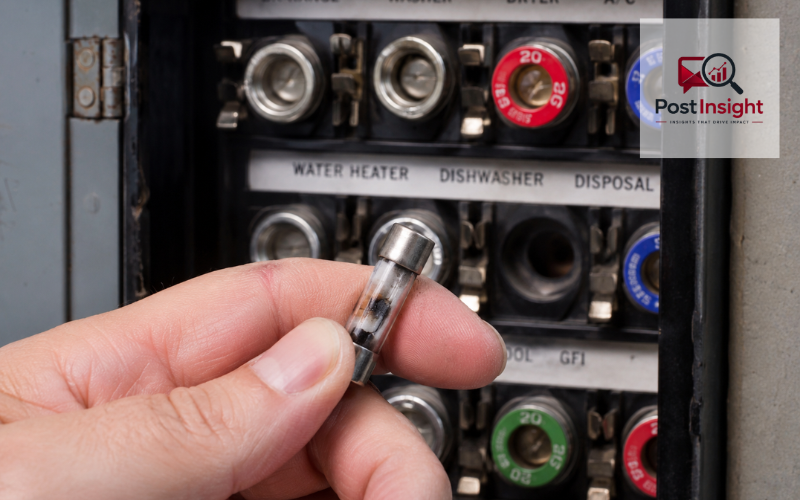
A blown fuse is a small electrical safety device that has stopped the flow of electricity because too much current passed through a circuit. Inside most fuses is a thin metal strip or wire. When the electrical current rises above a safe level, this metal part heats up and melts, opening the circuit before the wiring or connected equipment becomes dangerously hot.
Fuses are used in many places. Older homes may have a fuse box instead of a modern circuit-breaker panel. Vehicles use small automotive fuses to protect lights, power windows, radios, charging ports, and electronic controls. Some appliance plugs also contain replaceable fuses that protect the appliance and its power cord.
A single blown fuse does not always mean there is a major emergency. It may result from a temporary overload, such as using several high-power appliances on one circuit. However, repeated fuse failures, burning smells, melted plastic, sparks, or a hot fuse box can point to a dangerous wiring or equipment problem.
This guide explains the main blown fuse symptoms, why fuses fail, how to inspect and test them, and how to replace a fuse safely. It also covers household fuse boxes, plug fuses, automotive fuses, and the difference between a blown fuse and a tripped circuit breaker.
| Situation | Common Sign | Likely Cause | Recommended Action |
| Household circuit | One room or outlet loses power | Overload or wiring fault | Unplug devices and inspect the fuse |
| Appliance plug | Appliance stops working | Damaged plug fuse or appliance fault | Unplug and replace with the correct fuse |
| Car fuse | One electrical feature fails | Short circuit or faulty accessory | Check the fuse-box diagram and test the fuse |
| Repeated fuse failure | New fuse blows again | Short circuit, overload, or damaged wiring | Stop replacing it and call a professional |
| Burn marks or heat | Melted plastic, smell, or discoloration | Overheating or loose connection | Turn off power and request urgent inspection |
A fuse is designed to be the weakest safe point in an electrical circuit. Under normal conditions, electricity flows through the metal element inside the fuse and continues to the connected light, appliance, outlet, or vehicle component.
If the current becomes too high, the fuse element heats rapidly. Once it reaches its limit, the metal melts and creates a gap. Electricity can no longer travel across that gap, so the circuit immediately loses power. Electrical Safety First explains that this melting action disconnects a faulty or overloaded circuit and helps protect people and property.
That is why a lamp may suddenly go out, a kitchen appliance may stop working, or a car’s radio may lose power when a fuse blows. The failed fuse has interrupted the circuit as intended.
However, the fuse is usually not the original cause of the problem. It reacts to another condition, such as excessive demand, damaged wiring, moisture, or a faulty appliance. Simply installing a new fuse without identifying the cause may result in another failure.
One of the most common causes is a circuit overload. This happens when connected devices try to draw more electrical current than the circuit and fuse are designed to handle. For example, using a microwave, electric kettle, toaster, and portable heater on the same circuit may place too much demand on it. Overloaded extension leads and sockets can also overheat and create a fire risk.
A short circuit is another possible cause. It occurs when electricity takes an unintended low-resistance path, often because damaged wires touch each other. This can produce a sudden and very large current increase, causing the fuse to blow almost instantly.
A ground fault happens when electricity escapes from its intended path and reaches a grounded metal part, earth wire, or another conductive surface. Moisture, damaged insulation, and loose wiring can contribute to ground faults.
Faulty equipment may also cause a blown fuse. A damaged motor, heating element, power supply, charger, or internal wire can draw too much current. In vehicles, incorrectly installed accessories, trailer wiring, aftermarket audio equipment, or damaged wiring near moving parts may lead to repeated fuse failure.
Loose connections, corrosion, aging insulation, water entry, and physical damage are other possible causes. These faults should not be ignored because they may produce heat or electrical arcing before the fuse operates.
The most obvious symptom is a sudden loss of power. One room, outlet, appliance, plug, light, or car feature may stop working while everything else continues to operate normally.
Some glass fuses make the failure easy to see. The metal wire inside may be broken, the glass may look cloudy, or there may be a brown or black mark. Blade-style car fuses may show a broken metal bridge through the transparent plastic body.
Not every damaged fuse looks obviously burned, however. Ceramic fuses and some automotive fuses can fail without a clear visual sign. Testing may therefore be necessary.
More serious warning signs include repeated fuse failure, a hot fuse box, buzzing or crackling sounds, scorch marks, melted plastic, sparks, smoke, or a burning smell. The NFPA identifies frequently blown fuses, warm or discolored electrical parts, and unusual electrical behavior as signs that a system may need professional attention.
Do not continue using equipment that produces these symptoms. Disconnect it safely when possible and arrange an inspection.
A blown fuse is not automatically dangerous. In many cases, it means the safety device has performed its job correctly by stopping an unsafe current before the wiring or equipment overheated.
The condition that caused the blown fuse may still be dangerous, though. A short circuit, damaged cable, faulty appliance, or loose connection remains present after the fuse has operated. Installing another fuse without correcting the fault can restore power to an unsafe circuit.
Repeatedly blown fuses are a particularly important warning. They may indicate that a circuit is consistently overloaded or that damaged wiring is allowing electricity to flow where it should not.
Never solve the problem by installing a fuse with a higher amperage rating. A higher-rated fuse may allow more current to pass than the wiring can safely carry. The wires could then overheat before the fuse operates, increasing the risk of insulation damage or fire. Safety guidance recommends correcting the reason for the failure and replacing the fuse only with one of the same rating.
Always disconnect the power before removing or testing a fuse. For household circuits, this may mean switching off the main supply or the correct disconnect. For appliances, unplug the device. For a vehicle, turn off the ignition and all electrical accessories before opening the fuse box.
Start with a visual check. Look for a broken internal wire, a melted metal bridge, dark marks, cloudiness, or heat damage. Also inspect the fuse holder. A damaged or discolored holder may indicate overheating and should be professionally checked rather than simply fitted with another fuse.
When the damage is not visible, a digital multimeter can confirm whether the fuse still has continuity. Set the meter to continuity mode or the lowest resistance range. Touch one probe to each metal end of the removed fuse.
A good fuse normally produces a beep in continuity mode or a resistance reading close to zero ohms. A blown fuse normally produces no beep and may display “OL,” “open,” or a very high resistance reading. Fluke recommends removing power before continuity testing and explains that continuity mode checks whether a complete electrical path exists.
Do not use resistance or continuity mode on a live circuit. If you are uncertain about isolating the power safely, leave the test to a qualified person.
A fuse box is a central point that distributes electricity and protects individual circuits. In older homes, it may contain screw-in, cartridge, or rewirable fuses. In vehicles, one or more fuse boxes may be located under the dashboard, in the engine compartment, behind a trim panel, or in the luggage area.
Each fuse has a specific electrical rating. The amperage rating shows how much current it is designed to carry. The voltage rating shows the maximum system voltage for which the fuse is suitable. Fuses may also differ in physical size, construction, breaking capacity, and operating speed.
Some fuses act quickly, while time-delay or slow-blow fuses can tolerate brief startup surges from motors or other equipment. Even when two fuses have the same amperage, they may not be interchangeable if their size, voltage, type, or speed differs.
Use the fuse-box label, appliance instructions, vehicle owner’s manual, or manufacturer’s wiring information to identify the correct replacement. Never rely only on appearance or color, especially when markings are worn or unclear.
Before replacing a household or appliance fuse, turn off and unplug devices connected to the affected circuit. This reduces the load and helps prevent the replacement from failing as soon as power returns.
Next, disconnect the relevant power supply. Remove the old fuse using the correct method. Screw-in fuses should be handled only after the supply has been safely isolated. Cartridge fuses may require an insulated puller. Do not use metal tools that could touch energized parts.
Compare the old fuse with the replacement. The amperage, voltage, physical dimensions, operating type, and other specifications should match. Do not insert foil, wire, coins, or another object in place of a fuse. Such methods remove the designed protection and can expose the circuit to severe overheating.
Install the new fuse securely, close the fuse-box cover, and restore power. Turn devices back on one at a time. If the fuse fails again, stop. Do not keep fitting replacements. The circuit or connected equipment needs further investigation.
In homes, frequent fuse failures or circuit-breaker trips should be checked by a registered or licensed electrician.
Some appliance plugs, especially those used in the United Kingdom and certain other markets, contain a replaceable cartridge fuse. This fuse helps protect the appliance cable if a fault causes excessive current.
A blown fuse in a plug may cause the appliance to stop working even though the wall outlet still has power. Before checking it, unplug the appliance. Open the fuse compartment only as directed by the plug or appliance manufacturer.
Remove the fuse and inspect or test it. Replace it with the specified type and rating. Common plug fuse ratings are not interchangeable simply because they fit. The correct rating depends on the appliance and cable.
A failed plug fuse may be caused by an internal appliance fault, a damaged cord, a loose plug connection, or an overload. Examine the cable and plug for cuts, exposed wires, burn marks, loose pins, or melting. Do not reuse a damaged plug or cord. Replacing the fuse alone is not enough when the surrounding parts have been overheated or physically damaged.
A blown fuse in a car usually affects one specific electrical function or a small group of related functions. The headlights, radio, horn, power socket, interior lights, cooling fan, power windows, or another accessory may suddenly stop working.
Most vehicles have several fuse boxes. Their locations and fuse assignments vary widely, so check the owner’s manual or the diagram printed inside the fuse-box cover. The diagram identifies which fuse protects each system.
Automotive blade fuses are often color-coded by amperage, but color alone should not be your only guide. The printed amp number, physical size, and fuse type must also match.
Common causes include a faulty accessory, damaged wiring, water entry, a worn motor, a shorted light socket, or incorrectly installed aftermarket equipment. Coins or metal objects inside a 12-volt power socket can also create a short circuit.
Some modern vehicles contain high-current fuses and complex electronic modules. These parts may require special service procedures. Do not work on hybrid or electric-vehicle high-voltage systems unless you are properly trained.
Turn off the engine, remove the key when applicable, and switch off all electrical accessories. Open the correct fuse box and locate the suspected fuse using the diagram.
Use the plastic fuse puller supplied with the vehicle or another appropriate insulated tool. Pull the fuse straight out without twisting or damaging the holder. Inspect the internal metal link or test the removed fuse with a multimeter.
Install a replacement that matches the original fuse’s type and amperage. Manufacturer service guidance commonly requires the same fuse type and amp rating rather than an improvised substitute.
After replacement, turn on the ignition and test the affected feature. If the new fuse blows immediately, do not install a larger one and do not keep replacing it. An active short circuit, faulty component, or wiring problem is likely present.
A mechanic or automotive electrician should diagnose faults involving major control modules, engine-management systems, airbags, anti-lock brakes, electric power steering, battery protection, or repeated unexplained fuse failures.
The phrase blown fuse in circuit breaker is commonly used, but fuses and circuit breakers are different protective devices.
A traditional fuse contains a metal element that melts and must be replaced after it operates. A circuit breaker uses an internal switching mechanism that trips open and can normally be reset after the fault has been removed.
Most modern electrical panels use circuit breakers rather than replaceable branch-circuit fuses. If one area of a home loses power, look for a breaker handle sitting between the fully on and fully off positions. After unplugging the affected devices, move the breaker fully off and then back on only once.
Some systems still contain both devices. Older fuse boxes use replaceable fuses, while air-conditioning units, industrial equipment, solar systems, and other installations may have fused disconnects alongside circuit breakers.
When a breaker will not reset, trips again immediately, feels hot, or shows signs of damage, leave it off and call an electrician. Treat it as a circuit fault rather than a simple reset problem.
A replacement fuse that keeps blowing is evidence that the underlying problem has not been corrected.
The circuit may still be overloaded because too many appliances are connected. One appliance may have an internal fault and draw excessive current each time it starts. Damaged insulation may be allowing wires to touch. A loose connection may be producing heat or arcing. Moisture may be reaching electrical parts.
The replacement itself may also be wrong. It could have the incorrect amp rating, physical size, voltage rating, or operating type. A fast-acting fuse may fail during a normal startup surge in equipment designed for a time-delay fuse, while an unsuitable higher-rated fuse may fail to protect the wiring properly.
To narrow down the cause, disconnect everything on the affected circuit before replacing the fuse. Restore power without reconnecting the devices. If the fuse remains intact, reconnect equipment one item at a time. Stop when the fault returns.
This basic approach may help identify a faulty portable appliance, but it is not a substitute for professional testing of fixed wiring. Do not repeatedly energize a circuit that produces smoke, heat, sparks, noise, or an immediate failure.
Professional help is appropriate when a replacement fuse blows immediately, the same fuse fails repeatedly, or the cause is not clear.
Call an electrician when the problem involves household wiring, a service panel, a damaged fuse holder, or a high-current appliance. Warning signs such as burning smells, buzzing, crackling, scorch marks, corrosion, melting, smoke, sparks, or unusual heat require prompt attention.
An automotive technician should investigate repeated failures involving vehicle wiring, control modules, safety systems, or high-current components. Modern cars contain sensitive electronic networks, and incorrect testing can cause additional damage.
Keep away from exposed electrical parts and do not touch a wet, smoking, or visibly damaged fuse box. If there is an active fire, leave the area and contact emergency services. Do not use water on energized electrical equipment.
A blown fuse is more than an inconvenience. It is a warning that the electrical current became higher than the circuit could safely handle. By melting and breaking the connection, the fuse helps protect wiring, appliances, vehicles, plugs, and electronic equipment from more serious damage.
In some cases, replacing the fuse with an exact match after removing an overload may solve the problem. However, the cause should always be considered before power is restored. A faulty appliance, short circuit, ground fault, damaged cable, or loose connection can remain dangerous even after the old fuse has been removed.
Always use the correct fuse type and rating, isolate the power before testing or replacement, and never install a higher-amperage fuse as a shortcut. When a fuse keeps blowing or you notice heat, smoke, sparks, damage, or burning smells, stop using the circuit and arrange a professional inspection. A careful response to a blown fuse can prevent equipment damage, electric shock, and electrical fire.
The most common cause is circuit overload, which happens when too many high-power devices draw electricity from the same circuit. Short circuits, faulty appliances, damaged wires, and moisture can also blow a fuse.
You may replace a simple plug or car fuse when you can safely disconnect the power and identify the exact replacement. Household wiring faults, heat damage, and repeated failures require a qualified professional.
The blown fuse itself usually shows that the safety system worked correctly. However, the overload, short circuit, damaged wiring, or faulty equipment that caused it may still create an electric-shock or fire risk.
Look for a broken internal wire, dark mark, melted bridge, or cloudy glass. A multimeter can confirm the fault: a good fuse shows continuity, while a blown fuse displays an open circuit.
An immediate failure normally indicates an active short circuit, ground fault, overloaded circuit, faulty component, or incorrect fuse. Do not install a larger fuse or continue replacing it without professional diagnosis.
Disclaimer: This article is provided for general informational and educational purposes only. Electrical systems can cause electric shock, burns, fires, equipment damage, or serious injury. Always disconnect power before inspecting a fuse and follow the manufacturer’s instructions. Do not replace a fuse with a higher amperage or an incompatible type. Contact a licensed electrician or qualified automotive technician when a fuse repeatedly blows, the fuse box is hot or damaged, or you notice sparks, smoke, buzzing, or burning smells.


