 11
11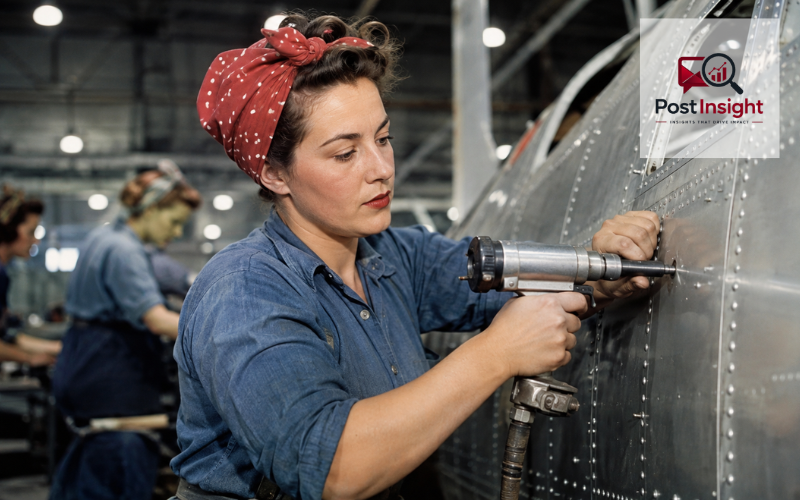
Rosie the Riveter is one of the most recognizable symbols of American women during World War II. She represents the millions of women who entered factories, shipyards, aircraft plants, and other workplaces while large numbers of men were serving in the military. More than six million women took wartime jobs, helping produce aircraft, ships, vehicles, weapons, and other supplies needed for the war effort.
However, Rosie was not simply one woman whose picture became famous. She developed as a cultural symbol through music, illustrations, photographs, advertising, and the experiences of real female workers.
Today, many people immediately picture the woman wearing a red-and-white polka-dot bandana and flexing her arm beneath the words “We Can Do It!” Yet that image was not originally known as Rosie the Riveter during the war.
Understanding Rosie means looking beyond one poster. Her story includes real workers, wartime propaganda, famous artwork, workplace struggles, changing ideas about women, and a legacy that continues decades later.
Note: Rosie the Riveter was a symbolic character, not one celebrity or historical individual. Therefore, she has no personal birth date, net worth, or family record.
| Detail | Information |
| Name | Rosie the Riveter |
| Date of Birth | Not applicable — Rosie was not one real person |
| Short Biography | A WWII cultural symbol representing American women who entered industrial and defense jobs, including riveting, welding, machining, and aircraft or ship production. |
| Net Worth | Not applicable — Rosie is a symbolic figure, not an individual with personal finances |
| Family | Not applicable — there is no single Rosie with a family biography |
| Historical Period | World War II, especially the early-to-mid 1940s |
| What She Represented | More than six million women who entered wartime employment in the United States. |
| Famous Image | J. Howard Miller’s “We Can Do It!” Westinghouse poster, later popularly associated with Rosie. |
| Main Work Represented | Riveting, welding, aircraft assembly, shipbuilding, machining, munitions production, and other defense work. |
| Major Recognition | Rosie the Riveters collectively received the Congressional Gold Medal; the U.S. Mint records the honor under 2024. |
When the United States entered World War II after the attack on Pearl Harbor in December 1941, the country faced a huge demand for workers. Millions of men entered military service, while factories had to greatly increase production.
Women became an essential part of the solution. They worked in jobs that had often been considered “men’s work,” including aircraft assembly, shipbuilding, welding, riveting, machining, and munitions production.
The change was especially dramatic in aviation. By 1943, more than 310,000 women were working in the American aircraft industry. Women made up a large share of workers in an industry where they had previously been uncommon.
This is the larger meaning of Rosie the Riveter WW2 history. Rosie did not represent only women who used rivet guns. She became a symbol for a much wider group of women whose labor supported the American home front.
Their work also challenged long-standing beliefs about what women were capable of doing in factories and heavy industry.
A common question is: Was Rosie the Riveter a real person?
The clearest answer is that Rosie was mainly a symbolic or composite character rather than one specific woman. Several real workers influenced different versions of Rosie, but no single person can accurately be called the only “real Rosie.”
The National WWII Museum describes Rosie as representing more than six million women from different backgrounds who entered the workforce to support the war effort.
Confusion exists because several real women later became associated with the name. Some inspired songs, some appeared in photographs, and others served as models for famous illustrations.
It is therefore more accurate to think of Rosie as a shared identity. A woman building aircraft in Connecticut, welding ships in California, or producing military equipment in Michigan could all be part of the real-life story behind Rosie the Riveter.
The Rosie identity developed before the famous bandana poster became widely connected with her.
One major turning point was the song “Rosie the Riveter,” written by Redd Evans and John Jacob Loeb. The song described a hardworking woman who spent her days helping the war effort through industrial work. The character combined patriotism with an image of a capable female factory worker.
According to the Library of Congress, wartime worker Rosalind P. Walter helped inspire the song. Walter began working as a riveter on Corsair fighter planes at the Vought Aircraft Company while still a young woman.
The song helped make “Rosie” a familiar name. Newspapers, radio, photographs, advertisements, and illustrations added to the image.
As more women entered wartime industries, Rosie became larger than the original song. She turned into a convenient name for women doing vital industrial work across the country.
Rosalind P. Walter is one of the most important real women connected with the Rosie story. After high school, she worked on Corsair fighter aircraft and became an inspiration for the wartime song that helped popularize the Rosie name.
She was not the only woman associated with the symbol.
Rose Will Monroe, who worked at the Willow Run aircraft plant in Michigan, became known as a real-life Rosie after appearing in wartime promotional material. Mary Doyle Keefe served as the model for Norman Rockwell’s famous Rosie illustration, although Rockwell made the painted figure much larger and more muscular than Keefe herself.
Other women became connected with different Rosie images over the years.
For this reason, searching for a single Rosie the Riveter model can be misleading. Different artists and media campaigns drew inspiration from different people.
Together, these individual stories help show that the most meaningful “model” for Rosie was the much larger generation of women who performed wartime work.
One of the most important wartime images of Rosie was created by American artist Norman Rockwell.
His painting appeared on the May 29, 1943, cover of The Saturday Evening Post. It showed a strong, muscular woman taking a break from factory work. She holds a rivet gun, has a lunch box marked with the name Rosie, and rests her feet on a copy of Adolf Hitler’s Mein Kampf. An American flag fills much of the background.
Rockwell’s Rosie looked different from the slim woman now commonly associated with the “We Can Do It!” poster. His figure was deliberately powerful and physically imposing.
The painting helped turn Rosie from the character of a popular song into a clear visual symbol of female wartime labor.
Because Rockwell’s illustration was widely seen during the war, it was one of the images most directly associated with Rosie at the time.
Today, the best-known Rosie the Riveter poster is probably J. Howard Miller’s “We Can Do It!” image.
Miller created the poster for Westinghouse Electric & Manufacturing Company as part of a series of workplace posters. Rather than being a nationwide government recruitment poster, it was designed as an internal work-incentive image for Westinghouse employees.
The poster was displayed at Westinghouse facilities for only a short period. Smithsonian research notes that it appeared for two weeks in February 1943.
Most importantly, the woman was not called Rosie on the original poster. The words “Rosie the Riveter” do not appear on it.
The connection developed much later. As the image gained renewed attention after the war, especially during later movements for women’s equality and empowerment, people increasingly identified the woman as Rosie.
That later association became so strong that the “We Can Do It!” figure eventually replaced other versions of Rosie in popular memory.
The identity of the woman who may have inspired Miller’s famous poster has been debated for years.
For a long time, Geraldine Hoff Doyle was widely described as the possible inspiration. Later research questioned that identification and connected the source photograph more strongly with Naomi Parker Fraley, who worked in a machine shop at Naval Air Station Alameda in California during World War II.
Even here, it is useful to be careful. A photograph connected with Naomi Parker Fraley may have influenced the poster, but that does not make her the one and only Rosie the Riveter.
The term Rosie the Riveter woman can therefore refer to several different things: the fictional Rosie character, the woman depicted by an artist, a photographic inspiration, or any of the real wartime workers commonly called Rosies.
This distinction explains why different names appear when people research the identity behind the famous image.
The real Rosies performed demanding industrial jobs rather than simply posing for patriotic photographs.
Some women operated rivet guns to fasten sections of aircraft and ships together. Others became welders, machinists, electricians, inspectors, mechanics, assemblers, and production workers.
Women worked in aircraft factories, shipyards, munitions plants, vehicle factories, and many other defense industries. They produced equipment that American and Allied forces needed overseas.
Many women entered these fields without previous industrial experience and received training for specific wartime jobs. They learned how to use machinery, read production instructions, handle tools, and follow factory safety procedures.
Their contribution was not symbolic. The wartime economy depended on enormous levels of production, and women became a major part of the workforce that made this possible. The National Park Service continues to preserve the stories of these workers through collections and oral histories.
The cheerful and confident Rosie images told only part of the story.
Women often received lower pay than men and faced doubts about whether they belonged in industrial jobs. Some also experienced harassment, exhausting schedules, unsafe working environments, and the challenge of handling paid employment while remaining responsible for much of the work at home.
Race made these difficulties even greater for many workers.
Black women entered defense industries but continued to face racial discrimination. Segregation, unequal access to jobs, differences in benefits, and barriers within some unions limited their opportunities. Historical accounts show that Black and white women could both earn less than male workers, while Black workers faced additional discrimination because of race.
Other minority women also faced prejudice and unequal treatment.
Recognizing these realities does not reduce Rosie’s importance. Instead, it gives a fuller picture of what wartime women achieved while working within a society that still placed major limits on gender and racial equality.
When World War II ended in 1945, the demand for wartime production quickly declined.
Millions of servicemen returned home and needed civilian jobs. Many women who had entered factories during the war were laid off, replaced, or encouraged to leave industrial employment. Popular culture also returned to promoting more traditional ideas about women’s roles in the home.
For many Rosies, wartime employment was therefore temporary.
Yet the experience could not simply be erased. Women had already proved that they could successfully perform industrial and technical work that had once been described as unsuitable for them.
World War II did not create workplace equality, and many women continued to face barriers after the war. Still, the experience widened expectations about female employment and became an important part of the longer history of women’s participation in American working life.
Rosie’s later meaning grew partly because future generations looked back at these women as examples of independence, skill, and economic contribution.
People searching for Rosie the Riveter death sometimes expect to find one birth date and one death date. That information does not exist because Rosie was not a single historical person.
The individual women connected with the Rosie story each had their own lives.
Rosalind P. Walter, Mary Doyle Keefe, Rose Will Monroe, Naomi Parker Fraley, Elinor Otto, and many other wartime workers lived different lives and died at different times. Their personal histories should not be combined into one fictional biography.
This is also why oral-history projects are important.
The National Park Service and other historical organizations have recorded interviews with wartime workers so their experiences can be preserved in their own words. These records help historians move beyond the famous poster and understand what everyday life was actually like for women on the home front.
Rosie remains popular in books, museums, exhibitions, documentaries, classrooms, clothing, posters, and public events.
Someone looking for a Rosie the Riveter book can find several types of resources. Some books focus on the cultural symbol, while others collect biographies, photographs, oral histories, or accounts of women working on the World War II home front. Historical archives and museum collections are especially useful when readers want to separate documented history from later legends.
The familiar Rosie the Riveter costume usually includes work clothes or denim, a rolled-up sleeve, and a red bandana with white dots. Although this look is strongly associated with Rosie today, it largely reflects the later popularity of Miller’s “We Can Do It!” image rather than one standard uniform worn by all female war workers.
Rosie has also developed a meaning that goes beyond World War II. The image has been reused as a symbol of women’s strength, workplace opportunity, and empowerment.
Her historical importance received major official recognition when Congress collectively awarded the Rosie the Riveters the Congressional Gold Medal on April 10, 2024. The medal recognizes the women who joined the U.S. workforce during World War II and helped produce the aircraft, vehicles, weapons, ammunition, and other materials required for the war effort.
The U.S. Mint continues to list Rosie the Riveter among its Congressional Gold Medal honorees, keeping that recognition part of the official historical record.
Rosie the Riveter remains powerful because she represents far more than a famous woman flexing her arm on a poster.
There was no single Rosie. The symbol grew from a wartime song, real female workers, Norman Rockwell’s artwork, factory publicity, photographs, and eventually J. Howard Miller’s rediscovered “We Can Do It!” poster.
Behind those images were millions of women performing real and often difficult jobs. They built aircraft, welded ships, operated machinery, assembled military equipment, and helped keep American wartime production moving. At the same time, many dealt with lower pay, discrimination, demanding working conditions, and pressure to give up their positions once the war ended.
Understanding Rosie the Riveter therefore requires remembering both the inspiring symbol and the complicated experiences of the women behind it.
More than eight decades after World War II, Rosie continues to represent an important moment when millions of American women demonstrated, on an enormous scale, that their abilities extended far beyond the roles society had traditionally assigned to them.
No. Rosie the Riveter was mainly a cultural symbol representing millions of American women who worked in factories, shipyards, and other wartime industries during World War II.
There was no single “real Rosie.” Several women became associated with different versions of the character, while the larger symbol represented millions of female wartime workers.
Real-life Rosies performed jobs such as riveting, welding, machining, assembling aircraft, manufacturing ammunition, and working in shipyards and other defense-production facilities.
Today she is commonly called Rosie, but J. Howard Miller’s Westinghouse “We Can Do It!” poster was not originally presented as a Rosie the Riveter image during WWII.
Rosie represents women’s major contribution to wartime production and the broader change in perceptions of women’s ability to perform industrial jobs traditionally held by men.
Disclaimer: This article is provided for historical and educational purposes. Rosie the Riveter was a cultural symbol rather than one individual, so personal details such as birth date, family, and net worth do not apply.