
 11
11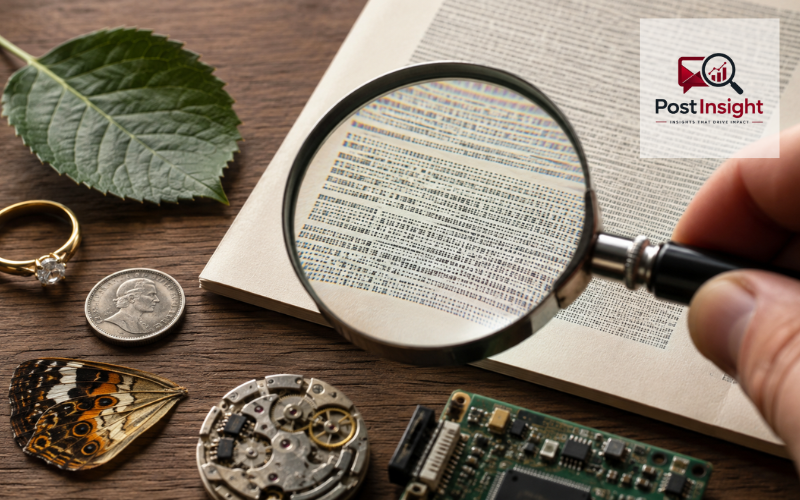
A magnifying glass is a simple optical tool used to make small objects, words, and fine details appear larger and easier to see. If you have ever struggled to read tiny instructions on a package or wanted a closer look at a coin, insect, piece of jewelry, or electronic part, a magnifying glass can make the task much easier.
So, what is a magnifying glass used for? Its main purpose is magnification. It does not physically increase the size of an object. Instead, its curved lens changes the way light reaches your eyes, creating an enlarged view of the object.
Magnifying glasses are useful in everyday life, but their uses go far beyond reading small print. Jewelers use them to inspect fine details, hobbyists use them for crafts and collectibles, students use them to explore natural specimens, and technicians may use magnification when working with tiny components.
Although smartphones and digital cameras can zoom in on objects, the traditional magnifying glass remains useful because it is simple, portable, inexpensive, and does not require electricity or software.
| Use | How It Helps |
| Reading | Enlarges small print and labels |
| Jewelry | Reveals tiny marks and details |
| Coins & Stamps | Helps inspect dates, textures, and damage |
| Nature Study | Shows details on insects, leaves, and rocks |
| Crafts & Repairs | Makes small parts easier to see |
| Electronics | Helps inspect components and solder joints |
A traditional magnifying glass consists of a convex lens held inside a frame. Most handheld versions also have a handle so the user can easily move the lens closer to or farther from an object.
A convex lens is thicker near the center than around the edges. Its shape bends light in a way that can make a nearby object appear larger when viewed through the lens.
The main purpose of a magnifying glass is to help the eye notice details that would otherwise be difficult to see. These might include tiny letters on a medicine bottle, a date stamped onto an old coin, a small scratch on a gemstone, or the texture of a leaf.
It is important to understand that magnification does not actually enlarge the object. A 5-millimeter detail remains 5 millimeters wide. The lens simply changes the image reaching your eyes so that the detail appears larger.
This makes a magnifying glass one of the simplest ways to examine small details without needing more advanced equipment.
To understand how does a magnifying glass work, it helps to know what happens when light passes through a convex lens.
Light normally travels in straight lines until it passes from one material into another, such as from air into glass. When it enters and leaves the curved lens, its direction changes. This bending of light is called refraction.
A convex lens causes light rays to bend toward each other. When an object is placed closer to the lens than its focal point, the eye sees an upright, enlarged virtual image. In simple terms, the image looks bigger even though it is not physically located where it appears to be. Physics descriptions of converging lenses confirm that placing an object inside the focal length produces an upright virtual image.
The strength of the magnifying effect depends partly on the lens shape and focal length. Generally, a lens with a shorter focal length can provide stronger magnification, although stronger magnification usually means you can see a smaller area at one time.
For practical use, you do not need to calculate focal length. Simply move the magnifying glass slowly toward or away from the object until the image becomes clear.
There are many practical uses of a magnifying glass, ranging from reading to science and repair work. Ten common examples are:
The type of magnifier needed depends on the task. A basic handheld lens may be enough for reading labels, while jewelry inspection or precision repair may require a stronger loupe or a hands-free magnifying system.
When people ask what is a magnifying glass used for in everyday life, reading is usually the most familiar example.
A magnifying glass can make medicine labels, food packaging, maps, menus, instruction manuals, receipts, and product information easier to read. It can also help when checking serial numbers, small screws, markings on household items, or other details that are difficult to see clearly.
Magnifiers can be especially convenient when you only need enlargement for a short task. Unlike a smartphone, a simple magnifying glass does not need a charged battery, an app, or a camera.
Digital zoom can still be useful, particularly when someone wants to enlarge an image greatly or save a photograph. However, a traditional magnifier gives an immediate view of the real object and can be moved naturally with the hand.
For many small everyday tasks, that simplicity is exactly what makes it useful.
Reading is one of the most common reasons people keep a magnifying glass at home.
Fine print appears on medication packaging, warranties, contracts, ingredient lists, instruction manuals, newspapers, books, maps, and many other everyday items. A magnifier can make these letters appear larger without changing the original document.
For occasional reading, a small handheld lens may be enough. For a larger page, a wider magnifier can allow the reader to see several words or lines at the same time.
Higher magnification is not automatically better. Strong lenses often provide a smaller viewing area and may need to be held at a more precise distance. For longer reading sessions, comfortable magnification with a reasonably wide field of view is usually more practical.
Good lighting also matters. An illuminated magnifier can be useful when the room is dim or when the material has poor contrast.
Magnification is valuable when examining objects whose important features may be extremely small.
On jewelry, a magnifier can reveal tiny hallmarks, scratches, settings, surface details, or possible damage. Gemstones can also be viewed more closely for visible inclusions and other features.
Coin collectors may use magnification to examine dates, mint marks, lettering, wear, scratches, and unusual surface details. Stamp collectors can inspect printing patterns, edges, cancellations, and possible damage.
For casual inspection, a normal magnifying glass can work well. Professionals often use a loupe, which is a small magnifier designed for close inspection. Jewelers commonly prefer loupes because they offer stronger magnification in a compact viewing area.
Magnification can help reveal details, but it does not automatically prove that an item is valuable or genuine. Professional authentication may require experience, measurements, testing equipment, and other forms of examination.
Small parts are common in crafts, electronics, watches, models, and other detailed work. A magnifying glass allows the user to see these parts more clearly while working.
People who sew, embroider, make jewelry, paint miniatures, or build scale models may use magnification to follow small patterns and work with fine details. Watch repair also involves extremely small gears, screws, springs, and other components that can be difficult to inspect with the naked eye.
Electronics work may involve tiny circuit-board markings, solder joints, wires, and components. Magnification helps technicians inspect these areas more closely.
For tasks that require both hands, a handheld magnifying glass may not be ideal. A stand magnifier, head-mounted magnifier, or illuminated desk magnifier leaves the hands free for tools and materials.
The goal is not simply to make everything as large as possible. A useful setup should provide enough enlargement while still giving the user room to work comfortably.
A magnifying glass is also a useful educational tool because it encourages people to examine ordinary objects more closely.
Leaves may reveal tiny veins, hairs, edges, and surface patterns. Flowers contain structures that are easier to study when enlarged. Rocks may show grains, crystals, cracks, or different textures. Insects can reveal detailed wings, legs, body patterns, and other features.
This makes magnifying glasses useful in classrooms, gardens, nature walks, and simple science activities.
However, a magnifying glass should not be confused with a microscope. A normal hand lens is useful for details that are small but still relatively easy to observe. Microscopes provide much greater magnification and can reveal structures that a basic magnifying glass cannot resolve.
For children and beginners exploring nature, a magnifying glass offers a simple introduction to careful observation without requiring complicated equipment.
Magnifying glasses come in many sizes, and larger is not always the same as stronger.
A magnifying glass big size usually provides a wider viewing area, which can be useful for books, newspapers, maps, photographs, and other large surfaces. It may allow the user to see more of the page without moving the lens as often.
Smaller lenses can sometimes provide stronger magnification but usually cover less of the object at one time.
Handheld magnifiers are portable and useful for quick tasks. Stand magnifiers rest above the material and can be more comfortable for longer activities. Illuminated magnifiers combine enlargement with built-in lighting, while large-page or sheet-style magnifiers are designed to cover a wider area.
The best option depends on whether the priority is portability, stronger magnification, a wide viewing area, hands-free use, or better lighting.
A basic magnifying glass drawing usually shows a round or oval convex lens surrounded by a frame and attached to a handle. Scientific diagrams may include a few additional features to explain how the lens works.
The most important parts are the convex lens, its central axis, the object being viewed, the focal point, and the path followed by light.
A simplified idea can be shown as:
Small object → convex lens → bent light rays → eye → enlarged-looking image
In a more detailed diagram, light rays coming from the object bend as they pass through the lens. When the object is positioned within the focal length, the eye traces those rays backward and perceives a larger, upright virtual image.
Lens diagrams may look technical at first, but the basic principle is simple: the curved transparent material changes the direction of light, allowing a nearby object to appear larger.
The history of the magnifying glass is more complicated than naming one inventor on one specific date.
People have used curved pieces of transparent material for magnification for centuries. Early forms sometimes called reading stones were placed over text to enlarge letters.
Roger Bacon, an English scholar and Franciscan friar, is frequently connected with the development of magnifying lenses. In the 13th century, he wrote about viewing small letters and objects through curved glass or crystal so they would appear larger. Historical accounts place his important written descriptions around 1267, rather than proving that he suddenly invented the modern handheld magnifying glass in a single year.
This matters for people searching who invented the magnifying glass in 1250. The year 1250 is sometimes associated loosely with medieval developments in lenses, but there is no strong reason to describe it as the exact year the magnifying glass was invented.
Earlier scholars also studied optics. Ibn al-Haytham, known in Europe as Alhazen, made major contributions to the understanding of light and vision centuries before Bacon, while medieval European scholars continued developing knowledge about curved lenses.
Therefore, the most accurate answer to who invented magnifying glass is that no single person can confidently be credited with inventing every form of it. Roger Bacon is important in its medieval history because of his written work on convex lenses and magnification, but magnifying devices developed gradually from earlier knowledge of lenses and optics.
Using a magnifying glass normally requires only a little adjustment. Start by holding the lens between your eyes and the object. Move the lens slowly until the image becomes sharp and comfortably enlarged.
Good lighting helps, especially when reading or examining a dark object. Keep the lens clean because fingerprints, dust, and scratches can reduce image clarity. A soft lens or microfiber cloth is usually suitable for removing light dust and marks.
One important safety rule is to never look directly at the Sun through a magnifying glass. Optical lenses can concentrate intense sunlight, creating a serious risk of eye injury. Safety guidance for solar viewing warns against looking at the Sun through optical devices unless they are equipped with suitable solar protection specifically designed for that purpose.
A magnifying lens can also concentrate sunlight onto a small spot and generate enough heat to ignite some materials. For that reason, do not leave a magnifying glass where direct sunlight can be focused onto paper, fabric, dry vegetation, furniture, or other flammable surfaces.
When you are finished, store the lens somewhere clean and protected from scratches, impacts, and strong direct sunlight.
So, what is a magnifying glass used for? At its simplest, it helps people see small words, objects, and fine details more clearly by making them appear larger.
Its uses range from reading labels and documents to inspecting jewelry, coins, stamps, electronic parts, crafts, plants, insects, and other small objects. Magnifying glasses are also useful for education, nature study, hobbies, and precision work.
Different designs serve different needs. A handheld magnifier is convenient for everyday use, while large, illuminated, stand-mounted, or specialized magnifiers may be better for reading or detailed work.
The science behind the tool is simple but effective: a convex lens bends light so that a nearby object can appear enlarged to the viewer. Even with digital cameras and smartphone zoom readily available today, the magnifying glass remains useful because it provides quick, direct magnification without batteries, software, or complicated equipment.
A magnifying glass is mainly used to enlarge the appearance of small objects, fine print, and tiny details, making them easier to see and inspect.
Its convex lens bends light rays so that a nearby object appears larger to your eyes. The object itself does not physically increase in size.
Yes. It can make small text on books, medicine bottles, menus, maps, product labels, and instruction manuals easier to read.
You can examine jewelry, coins, stamps, insects, leaves, rocks, photographs, electronic components, crafts, and other objects with small or difficult-to-see details.
Use care around direct sunlight. Never look at the Sun through a magnifying glass, and avoid focusing sunlight onto flammable materials because concentrated light can cause burns or fire.
Disclaimer: This article is for general informational purposes. Always use magnifying glasses safely, especially around direct sunlight, heat, delicate objects, and precision repair work.