
 11
11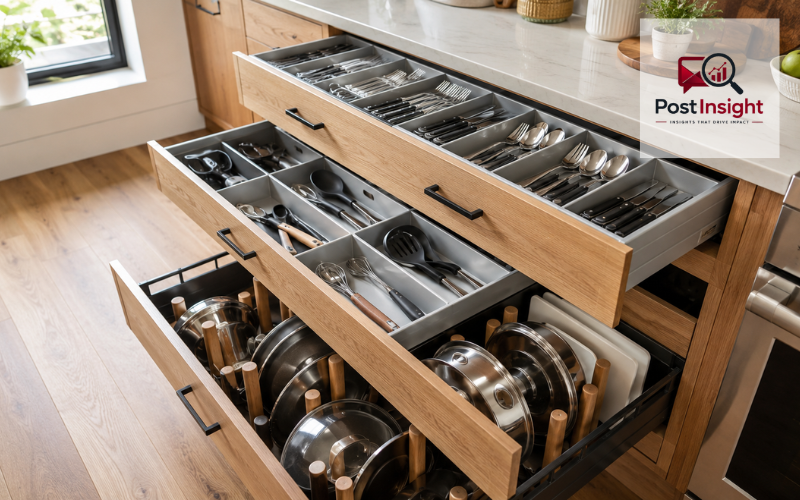
Learning how to organize kitchen drawers is not only about making them look neat. A well-planned drawer system can make cooking faster, reduce frustration, and help everyone in the home return items to the right place. When drawers are crowded with duplicate tools, loose clips, mismatched utensils, and items that belong elsewhere, even a simple task can turn into a search.
The most effective method is straightforward: empty the drawers, remove what is not needed, group similar items, measure the available space, add suitable dividers, and arrange everything around the way the kitchen is actually used. This order matters. Buying containers first often creates a second problem because the organizers may not fit the drawers or the items you need to store.
A useful kitchen drawer organization layout should support daily habits rather than copy a perfect-looking picture. Store each tool where you naturally use it so the system remains easy to maintain.
| Step | What to Do | Why It Helps |
| Empty | Remove everything from each drawer | Reveals hidden clutter and unused items |
| Declutter | Discard broken tools and remove duplicates | Creates more usable storage space |
| Clean | Vacuum crumbs and wipe drawer interiors | Provides a clean base for organizers |
| Measure | Record drawer width, depth, and height | Prevents buying organizers that do not fit |
| Group | Sort items by purpose and frequency of use | Makes related tools easier to find |
| Create zones | Store tools near where they are used | Improves cooking and cleaning workflow |
| Add organizers | Use trays, bins, pegs, or dividers | Keeps items separated and accessible |
| Maintain | Return items after use and review regularly | Prevents clutter from building up again |
Start by removing everything from the drawers you plan to organize. Take out utensils, cutlery trays, drawer liners, batteries, clips, instruction manuals, and every other loose item. Place everything on a clean counter or table where you can see it clearly.
Emptying the drawers completely gives you an honest picture of what you own. It also reveals objects that have slipped behind organizers or become hidden under larger utensils. Trying to organize around existing clutter usually leads to small improvements rather than a lasting system.
If the whole kitchen feels overwhelming, work on one group of drawers at a time. Still empty each selected drawer fully so you can compare similar items and assign the space properly.
Before putting anything back, inspect every item. Discard tools that are cracked, rusted, melted, badly stained, or no longer safe to use. Remove expired products and organizers that are damaged or difficult to clean.
Next, look for duplicates. Many kitchens slowly collect several peelers, can openers, whisks, and serving spoons. Keeping a backup can make sense for tools used frequently, but several versions of the same rarely used gadget usually create unnecessary clutter. Choose the item that works best and let go of the extras.
Donate functional tools you no longer need. Be realistic about items saved for “someday,” especially when another utensil can do the same job. Community discussions repeatedly emphasize that dividers work better after excess items have been removed, not as a way to squeeze in more clutter.
Once the drawers are empty, vacuum loose crumbs from the corners and along the runners. Wipe the base and sides with a suitable cleaner, then allow the drawer to dry before adding a liner or organizer. Removable liners can make future cleaning easier, but they should lie flat and should not stop the drawer from closing smoothly.
Measure the inside width, depth, and usable height of each drawer. Measure more than once, especially if the sides narrow toward the bottom. Note where handles, screws, runners, or curved corners reduce the available space. A tray that matches the top measurement may still fail to sit flat inside.
Measure the longest utensils as well, especially rolling pins, whisks, serving spoons, and large knives. IKEA’s organizer guidance also recommends choosing inserts according to both drawer dimensions and the items being stored.
Sort everything into clear groups before assigning drawers. Common categories include everyday flatware, cooking utensils, preparation tools, baking equipment, food-storage supplies, dish towels, and small miscellaneous items. Keep the groups broad enough to be easy to remember.
Within each group, separate frequently used items from occasional tools. A vegetable peeler used several times a week should be easier to reach than a specialty decorating tool used twice a year. Seasonal or rarely used items can go at the back of a deep drawer, in a lower cabinet, or in a labeled container elsewhere.
Decide what should not return to a drawer. Heavy appliances may belong in a cabinet, frequently used utensils may work better on hooks, and pens or batteries may need a separate utility space.
Before adding containers, give each drawer a clear job. One might hold flatware, another cooking utensils, and another food-storage products such as foil, parchment paper, reusable bags, and clips. Clear purposes make it easier to put items away and notice when something does not belong.
Use the most accessible top drawers for objects reached for every day. Lower or less convenient drawers are better for bulky or occasional items. Keep the front part of each drawer for the most frequently used tools and place less-used items toward the back, provided they remain visible and easy to remove.
Avoid packing every inch. Open space makes utensils easier to lift out and leaves room for a useful new item. Test the layout with temporary bins or cardboard dividers before making anything permanent, then adjust it if people naturally reach elsewhere.
A zone-based system organizes tools near the place where they are used. Around the stove, store spatulas, wooden spoons, tongs, pot holders, and other tools needed while cooking. Close to the main preparation surface, keep knives, peelers, graters, measuring spoons, and small cutting tools.
Near the sink, drawers may hold clean dish towels, cleaning cloths, spare sponges, and trash or recycling bags. Store cleaning products safely, particularly in homes with children or pets, and follow the directions on their labels. The dining or serving area may be the best location for flatware, serving spoons, napkins, and trivets.
Zones will depend on the kitchen’s size and layout, but the goal is to reduce unnecessary movement. Reddit organization discussions often recommend dividing utensils by where and how they are used instead of placing every tool in one crowded drawer.
Small drawers require careful selection. Begin with essential items and move bulky tools to a more suitable location. Slim cutlery trays, narrow bins, and low-profile inserts can create separation without using too much space.
Choose organizers that fit the items rather than forcing every category into identical compartments. Measuring spoons may need a short narrow bin, while a peeler and can opener may share a wider section. If a tray leaves an awkward strip of empty space, use that area for a long tool or add a narrow container.
Stackable inserts can help when the drawer is deep enough, but they should not hide everyday items. Angled storage may make knives or small spice containers easier to see, while vertical compartments can work for short lids or boards if the drawer has enough height.
Do not over-divide. In a very small drawer, one tray and one open area may work better than many tiny sections.
Deep drawers are useful for pots, pans, mixing bowls, dishes, food-storage containers, and small appliances. However, they can become messy when items slide, stack too high, or disappear under one another.
Adjustable peg systems are helpful for separating stacks of plates, bowls, and cookware. Pegs can be moved when the contents change and can reduce movement as the drawer opens. Vertical dividers are a good option for pot lids, cutting boards, baking trays, and shallow pans because they allow each item to be removed without lifting an entire stack. IKEA currently lists both pegboard drawer organizers and extendable lid-storage solutions, illustrating the types of adjustable systems available for deep storage.
Use bins with handles for smaller objects that would otherwise collect at the bottom. A baking bin might hold cookie cutters, piping tools, and measuring cups, while another bin could hold food-storage lids. Pull-out containers are especially useful when the drawer is too deep to view comfortably from above.
Before storing heavy cookware, make sure the drawer operates smoothly and is suitable for the load.
Large utensils need more room than standard flatware. A kitchen drawer organizer for large utensils should have long, open sections that fit spatulas, ladles, whisks, tongs, and serving spoons without forcing them to overlap heavily.
Group tools by use. Keep stirring spoons together, place turning tools in another row, and give whisks or serving pieces their own section. Tongs can be held closed with their built-in lock or a simple band so they do not spread across the drawer.
Diagonal dividers can use wide drawers efficiently because they create longer compartments. Tension dividers or adjustable inserts are useful when the collection changes. However, tension should be gentle enough not to strain the drawer sides. Another option is to keep only the utensils used at the stove in the nearest drawer and move baking or serving tools to a separate location.
If an oversized tool prevents the drawer from closing, move it to a deeper drawer, cabinet, upright container, or wall-mounted system.
Expandable trays work well for flatware because their width can be adjusted to use more of the drawer. Modular bins are flexible for gadgets, clips, measuring tools, and small accessories. Adjustable dividers create long compartments and can be moved as storage needs change.
IKEA-style kitchen drawer organizers are based on a mix-and-match approach. Current ranges include cutlery trays, utensil trays, knife racks, dividers, pegboards, and inserts made from materials such as plastic, bamboo, and felt. The useful idea is not to copy one brand’s display, but to combine pieces that fit your actual drawer and belongings.
Plastic is usually light and easy to wipe, while bamboo should be kept dry and cleaned according to its care instructions. Felted inserts can reduce movement but may require more careful cleaning. Removable trays are often easier to maintain, and non-slip pads can stop lightweight bins from sliding.
A custom solution can be useful when drawers have unusual measurements. Thin wood strips can create strong dividers, while foam board or sturdy cardboard can be cut for lighter items. Smooth all edges and make sure the material will not scratch the drawer or shed particles.
Small boxes can be reused for clips, tea tools, measuring spoons, and other lightweight objects. Trim them to a consistent height and cover rough edges. Washable plastic food containers can also work as modular bins, provided they fit securely and remain easy to remove.
Test homemade dividers before fixing them in place. Make sure tall utensils do not catch and that each section is wide enough for your hand. Community suggestions include repurposed boxes and custom-cut dividers, but the key is to build around the drawer’s real dimensions.
One of the most common mistakes is buying organizers before measuring. Attractive trays can waste space if they are too small, while oversized inserts may stop the drawer from closing. Another mistake is choosing compartments based on appearance rather than the size and number of items.
Keeping too many duplicates is also a problem. Dividers cannot make an overcrowded drawer convenient. If utensils must be stacked in several layers or pushed down to close the drawer, the collection needs another review.
Avoid mixing unrelated items simply because space is available. A compartment containing batteries, barbecue skewers, tape, medicine spoons, and appliance parts will quickly become difficult to manage. If a miscellaneous drawer is necessary, give it defined categories and limit what can enter.
Finally, do not fill every gap. An organizer should improve access, not maximize how many objects can be hidden.
The system will last only if it is simple enough for daily life. Return items to their assigned places and make sure the layout is clear to everyone who uses the kitchen. Labels can help inside deep drawers or shared households, but they are not necessary when the categories are obvious.
Review the drawers every few months. Remove broken items, return misplaced objects, and check whether new purchases have created duplicates. Wipe the organizers while the drawers are partly empty. A brief reset is usually easier than waiting for the entire kitchen to become cluttered again.
Pay attention to repeated problems. If tools are often left out or dividers keep shifting, the location or organizer may not suit the household’s habits.
Practical advice shared in Reddit organization communities follows the same pattern: declutter before adding organizers, group tools by function or place of use, keep frequent items accessible, and adjust systems that do not work in real life. These are useful habits because they focus on behavior rather than a one-time visual makeover.
Knowing how to organize kitchen drawers comes down to a few dependable steps: remove everything, declutter honestly, clean and measure the space, group items by purpose, and place each group near the area where it is used. Organizers should support this plan rather than replace it.
The best kitchen drawer organization layout is not necessarily the most decorative one. It is the layout that makes everyday tools easy to find, remove, clean, and return. Small drawers benefit from careful editing and slim inserts, while deep drawers work best with pegs, bins, or vertical dividers that prevent items from becoming buried.
Keep the system flexible. Cooking habits, household needs, and kitchen tools can change over time. A simple arrangement with clear zones is easier to adjust and much easier to maintain than a drawer packed with highly specific compartments. When every item has a practical place, organized drawers become a natural part of the kitchen rather than a constant project.
Empty each drawer, remove broken or duplicate items, group tools by function, and place frequently used utensils in accessible drawers near the area where they are normally used.
Reuse small boxes, clean food containers, or custom-cut cardboard as dividers. Arrange them securely so they separate items without moving around or preventing the drawer from closing.
Use adjustable pegs, handled bins, or vertical dividers. These solutions keep pots, lids, bowls, cutting boards, and food-storage containers visible instead of allowing them to become buried.
Top drawers are best for frequently used items such as flatware, knives, peelers, measuring spoons, and cooking utensils. Place each category near the kitchen zone where it is used.
Check your drawers every few months and remove anything broken, duplicated, or misplaced. Small, regular resets are easier than waiting until the drawers become overcrowded again.
Disclaimer: This article provides general kitchen organization and storage information. Drawer sizes, weight limits, materials, and household safety needs may vary. Always follow product instructions and store knives, cleaning products, and potentially dangerous items safely, especially around children and pets.