
 11
11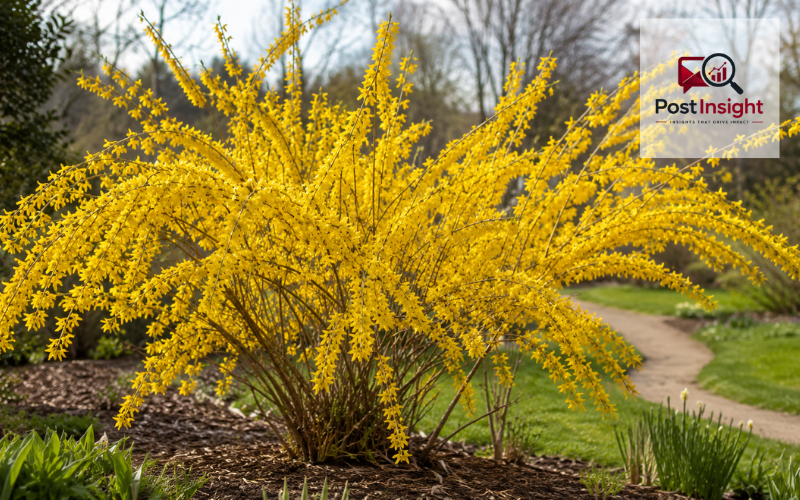
Forsythia is a deciduous flowering shrub best known for covering its bare branches with bright yellow blooms at the end of winter or the beginning of spring. It belongs to the olive family, Oleaceae, which also includes lilacs, jasmine, and privet. Because its flowers often appear before most garden plants have started growing again, forsythia is widely viewed as one of the first clear signs that spring is arriving.
The shrub remains bare through winter. As temperatures rise, clusters of bell-shaped flowers open along older stems, followed by green leaves. This flowers-first growth creates its strong spring impact.
Forsythia is easy to grow, but size and pruning matter. Compact cultivars fit small borders, while traditional types form broad, arching shrubs. The right variety, enough sun, and timely pruning support healthy growth and flowering. The plant can also be propagated, while one species has a separate history in traditional Chinese medicine.
| Feature | Quick Information |
| Plant type | Deciduous flowering shrub |
| Flower color | Bright or golden yellow |
| Bloom time | Late winter to early spring |
| Sunlight | Full sun to partial shade |
| Soil | Moist but well-draining soil |
| Mature size | About 2–10 feet, depending on variety |
| Hardiness | Commonly USDA zones 4–9 |
| Watering | Regularly during the first growing season |
| Pruning time | Immediately after flowering |
| Propagation | Cuttings or layering |
| Common uses | Hedges, screens, borders, slopes, and specimen planting |
The name forsythia honors William Forsyth, an eighteenth-century Scottish botanist and horticulturist who served as superintendent of the royal gardens at Kensington Palace. The botanical name was formed from his surname rather than from a word describing the plant’s yellow color or spring flowering.
In everyday English, forsythia is commonly pronounced “for-SITH-ee-uh.” You may also hear “for-SY-thee-uh,” which more closely reflects the name Forsyth. Both versions are understood, although pronunciation guides vary.
Because it flowers as winter ends, forsythia is often associated with hope and renewal. These are cultural meanings, not botanical definitions. “Forsythia NYC” may refer to a Roman-style New York restaurant, not a shrub variety.
Forsythia flowers are usually clear yellow or golden yellow, although the exact shade depends on the species and cultivar. Each flower has a short tube and four spreading lobes that create a bell-like or star-like shape. The flowers may appear singly or in small clusters, but they are produced so freely that a healthy shrub can look almost completely yellow from a distance.
Bloom time depends on climate. Flowers may open in late winter in mild areas but wait until April or early May in colder regions. Hard freezes can damage open blooms without killing the shrub.
After flowering, opposite pairs of medium-green, often toothed leaves appear. Through summer, forsythia becomes a leafy background shrub. Fall color varies, with some plants developing yellow or purple-tinged foliage.
Forsythia is considered a fast-growing shrub. Once established, it produces vigorous new stems from the base and can fill an open space quickly. Its final size depends heavily on the cultivar. Small selections may stay around 2 to 4 feet tall, while larger border forsythias often reach 6 to 10 feet and may spread just as wide or wider.
The natural form is commonly upright, rounded, mounded, or fountain-shaped. Many older cultivars have long stems that rise from the center and arch outward. Tight shearing can hide this graceful form and leave dense outer growth around a bare center.
Hardiness also varies. Many common garden forsythias perform well in USDA zones 5 through 8, while cold-hardy selections can grow in zone 3 or 4. In very cold climates, the branches may survive while exposed flower buds are killed. This can cause flowers to appear only near the bottom of the shrub, where snow protected the buds.
Gardeners in colder regions should look for cultivars selected for flower-bud hardiness, such as ‘Northern Sun,’ ‘Northern Gold,’ or ‘Meadowlark.’
Border forsythia, or Forsythia × intermedia, is the type most often seen in home landscapes. It is a hybrid of weeping forsythia and greenstem forsythia. It usually has an upright-to-arching shape, heavy flowering, and enough size to work as a hedge, screen, or background shrub.
Weeping forsythia, Forsythia suspensa, has long, flexible stems that can trail down banks or be tied to a wall or fence. Branches touching moist soil may root naturally, which makes this species useful on slopes but also means it may spread beyond its original position.
Early forsythia, Forsythia ovata, is generally smaller and valued for early bloom and cold tolerance. Compact cultivars of different parentage are better choices for limited spaces. Low, spreading selections can work at the front of a border, while rounded dwarf cultivars may suit large containers.
Choose by purpose: upright plants suit screens, arching forms make good specimens, trailing types cover banks, and compact cultivars fit small gardens.
Forsythia Lynwood Gold is commonly sold under names such as ‘Lynwood Gold’ or ‘Lynwood Variety.’ It is a selection of Forsythia × intermedia known for its large, bright yellow flowers and strong spring display. The flowers cover the branches before the dark green leaves emerge.
A mature plant commonly reaches about 6 to 9 feet tall and can become roughly as wide. Its stems grow upright at first and then arch outward, creating a broad, fountain-like form. In autumn, the leaves may turn yellow with touches of purple.
Because of its size, Lynwood Gold works well as an informal flowering hedge, a seasonal privacy screen, a background plant in a mixed border, or a single specimen in an open lawn. It can also be planted in groups on banks or slopes. It is less suitable for a narrow foundation bed unless there is enough room for its width.
Base spacing on mature spread. Close planting forms a screen sooner but increases crowding, while wider spacing preserves the natural arching shape.
Forsythia grows in full sun or partial shade, but a position receiving at least six hours of direct sun normally gives the strongest flower display. Plants in heavier shade may survive and produce healthy leaves, yet flowering is often lighter and the stems may become loose or stretched.
The soil should drain well. Forsythia adapts to sand, loam, clay, and many ordinary garden soils, but it does not benefit from sitting in waterlogged ground. If rainwater remains in the planting area for long periods, improve drainage or choose a raised location.
Space matters as much as soil. Keep large cultivars away from narrow paths, windows, and small foundation beds, and consider mature spread near property lines. Weeping forms suit slopes, while flexible stems can be trained on a supported wall or fence with adequate airflow.
The easiest planting periods are spring and autumn, when the soil is workable and temperatures are moderate. Container-grown plants can be installed at other times if the ground is not frozen or extremely dry, but they require closer attention to watering.
Bare-root plants are normally sold and planted during the dormant season. They should be planted promptly so their roots do not dry out. If immediate planting is not possible, keep the roots cool and moist until the planting site is ready.
Check the cultivar’s mature width before digging. Make the hole wider than the roots but no deeper than needed. Loosen circling roots and keep the top of the root ball level with the soil. Spread bare roots naturally rather than forcing them into a narrow hole.
Backfill with the original soil, firm it gently, and water deeply. Add organic mulch over the root area but keep it away from the stems. This helps hold moisture while reducing the risk of damp material collecting against the base of the plant.
Give specimen plants close to their expected mature width. Hedges may be spaced more closely but will need regular thinning as the shrubs grow together.
Newly planted forsythia needs regular moisture during its first growing season. Water deeply enough to moisten the root area, then allow the upper soil to begin drying before watering again. Frequent light sprinkling encourages shallow roots, while deeper watering helps the plant establish a stronger root system.
Established shrubs tolerate some drought but may need water during long hot, dry periods. Wilting, dry subsoil, and weak growth suggest thirst, while constantly wet soil can cause root stress.
A 2- to 3-inch layer of mulch helps slow moisture loss and reduces weed growth. Keep the mulch spread broadly rather than piled against the stems, as thick mulch touching the plant can hold too much moisture around the base.
Forsythia usually grows well without routine feeding. If growth is weak, first check sunlight, drainage, soil moisture, and pruning. Fertilizer may help when a soil test shows a nutrient shortage, but heavy feeding can produce long, leafy stems without improving the flower display.
Forsythia forms its spring flowers on older wood produced during the previous growing season. This is why pruning time is important. The best time for normal pruning is immediately after flowering, before the shrub has spent much of the growing season forming next year’s flower buds.
Pruning in late summer, autumn, or winter may remove those buds and leave the plant with few flowers the following spring. Winter pruning may make the branches easier to see, but it is not the best choice when preserving the spring display is a priority.
For maintenance, remove a few old, thick stems at ground level, along with weak, damaged, crowded, or crossing growth. Shorten flowered branches to healthy outward-facing shoots instead of shearing everything evenly.
An old, badly overgrown forsythia can be renewed more strongly. One option is to remove part of the oldest wood each year. Another is to cut most stems close to the ground during dormancy. Hard renewal pruning usually sacrifices the next spring’s flowers, but a healthy plant often responds with vigorous new growth.
A lack of flowers is often caused by pruning at the wrong time. If the shrub was cut in late summer, autumn, or winter, many flower buds may have been removed. Too much shade can also reduce blooming, even when the foliage looks healthy.
Cold injury is another common cause in northern areas. When only the lower branches flower, snow may have protected those buds while exposed buds were damaged by winter temperatures or a late freeze. A young shrub may also need time to establish before producing its best display.
Forsythia has relatively few serious pest and disease problems, but leaf spot, crown gall, stem dieback, aphids, spider mites, and several other pests can occasionally appear. Yellowing combined with wet soil may indicate poor drainage, while a crowded center and many bare old stems suggest that thinning is overdue.
Relocate a healthy shrub if it lacks sun or has outgrown its site. Young plants may need better watering, while tangled older shrubs often need renewal pruning rather than fertilizer.
Forsythia is one of the easier shrubs to propagate. Softwood cuttings can be taken from flexible new growth after flowering, usually in late spring or early summer. Semi-hardwood cuttings can be taken later, once the new stems have become firmer but are not fully mature.
Cut a healthy, non-flowering shoot below a leaf joint, remove the lower leaves, and place it in moist rooting mix under bright, indirect light. Keep the mixture damp but not soaked. Resistance to a gentle tug and the appearance of fresh growth suggest that roots are forming.
Layering requires even less equipment. Bend a low branch to the ground, lightly scrape the underside where it touches the soil, and cover that section while leaving the growing tip exposed. Hold it in place with a stone or landscape pin.
Once a healthy root system has formed, cut the new plant away from the parent and transplant it during mild weather. Keep the soil evenly moist while the young shrub settles into its new position.
The phrase “forsythia medicine” usually refers to the dried fruit of Forsythia suspensa, not to the flowers or leaves of the common ornamental hedge. In Chinese, this medicinal material is called lian qiao, written 连翘. It has a long history in traditional Chinese medicine and is generally used as part of multi-herb formulas.
Traditional formulas use it for feverish illnesses, inflammation, swelling, and sore throat. Laboratory and animal studies report anti-inflammatory, antioxidant, antibacterial, and antiviral activity, but this does not prove safe, effective treatment in people. Stronger clinical evidence is still needed.
Gardeners should not collect fruit from an ornamental forsythia and use it as medicine. The shrub may be a hybrid or a different species, its identity may be uncertain, and garden chemicals or contamination may be present. Commercial herbal products can also differ in quality, purity, and strength.
Anyone who is pregnant, breastfeeding, taking prescription medicine, managing a long-term condition, or considering forsythia for a child should speak with a qualified healthcare professional first. Possible interactions and safe doses are not well established for self-treatment.
Forsythia products should not replace medical care for fever, breathing trouble, infection, or other serious symptoms.
Forsythia remains popular because few shrubs create such a bright display so early in the year. Its yellow flowers arrive before the leaves, bringing strong color to gardens that may still look bare after winter. Once established, the plant is adaptable, fast-growing, and generally easy to care for.
The best results come from matching the cultivar to the available space. Large arching forms need room to spread, while compact selections are easier to fit into small borders or containers. Full sun supports heavier flowering, well-drained soil protects the roots, and deep watering helps new plants establish.
Most importantly, prune soon after flowering so next year’s buds remain intact. With suitable space and simple care, forsythia can be a reliable sign of spring for years.
Yes. Forsythia is generally easy to grow when planted in a sunny location with well-draining soil. Newly planted shrubs need regular watering, but mature plants require relatively little care.
Prune forsythia immediately after its flowers fade in spring. Pruning later in the year can remove the flower buds that would have produced blooms the following spring.
Poor flowering may result from too much shade, late pruning, winter bud damage, young plant age, or overcrowded older stems. Improving sunlight and pruning correctly often restores blooming.
Forsythia size depends on the variety. Compact cultivars may remain 2–4 feet tall, while larger arching varieties can reach 6–10 feet in height and spread.
The dried fruit of Forsythia suspensa, known as lian qiao, is used in traditional Chinese medicine. Evidence for medical effectiveness is limited, so it should not replace professional healthcare.
Disclaimer: This article is for general gardening and educational purposes only. Information about forsythia medicine is not medical advice. Consult a qualified healthcare professional before using any herbal product.


