 11
11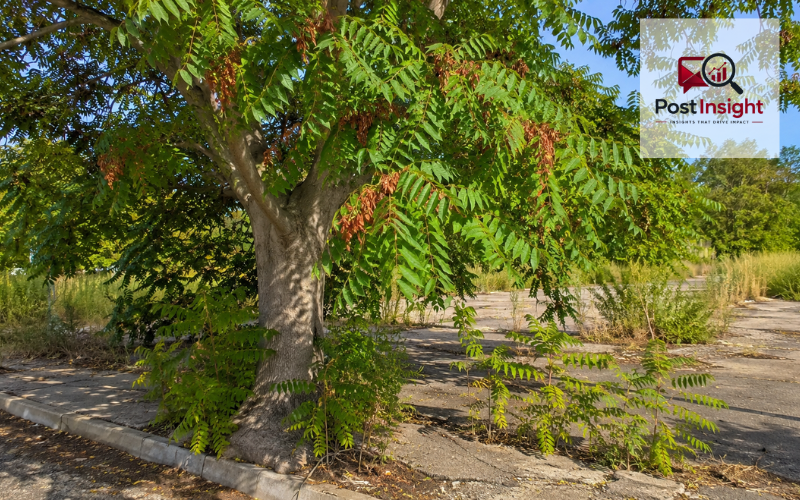
The Tree of Heaven, known scientifically as Ailanthus altissima, is a fast-growing deciduous tree from eastern Asia. It was brought to Europe and North America centuries ago because it grew quickly, tolerated difficult city conditions, and provided shade. Those same strengths later made it a serious invasive plant. It now spreads through roadsides, vacant land, woodland edges, river corridors, and urban areas. In the European Union, it is among the most widespread invasive alien species reported by member countries.
This article is about the invasive plant, not the Tree of Heaven K-drama. The tree deserves careful attention because it can be confused with useful native species, including black walnut and sumac. Correct identification matters before any cutting or treatment begins.
The sections below explain how to recognize the Tree of Heaven, where it grows, how it spreads, why it can damage natural and built environments, and how it should be removed. They also cover its connection with spotted lanternfly and the key differences between this invasive tree and its native look-alikes.
| Feature | Tree of Heaven |
| Scientific name | Ailanthus altissima |
| Leaf shape | Large compound leaves with many pointed leaflets |
| Leaflet edges | Mostly smooth, with small glandular teeth near the base |
| Smell | Strong, unpleasant odor when leaves or twigs are crushed |
| Bark | Pale gray and smooth, becoming slightly textured with age |
| Flowers | Small, pale green or yellowish clusters |
| Fruit | Twisted, papery winged seeds called samaras |
| Growth habit | Fast-growing tree that spreads through seeds and root suckers |
| Common look-alikes | Black walnut and native sumac |
| Removal warning | Cutting alone may trigger aggressive stump and root sprouts |
A mature Tree of Heaven can reach about 80 feet tall, although its final size depends on growing conditions. Young trees often shoot upward quickly and may gain several feet in a single year. Their crowns are usually upright or rounded, while young growth may look open, loose, and slightly irregular.
The leaves are one of the easiest features to notice. Each leaf is actually a long central stalk carrying many smaller leaflets. The complete leaf may be 1 to 4 feet long, giving the tree a tropical appearance during summer.
Most of the individual leaflets have smooth edges. However, one or two small teeth appear near the base of each leaflet. These teeth contain tiny glands and are among the most useful identification clues.
Another strong sign is the smell. When a leaflet, twig, or young stem is crushed, it often releases a sharp and unpleasant odor. People compare it to burnt nuts, rancid peanut butter, or other spoiled food. Smell alone should not be used for identification, but it can support the other visible features.
The bark is pale gray and usually lacks the deep cracks found on many mature native trees. As the trunk ages, its surface may develop shallow wrinkles that resemble the skin of a cantaloupe.
New Tree of Heaven leaves often have a reddish, purple, or bronze color before turning green. This colorful young growth can make seedlings and root sprouts easier to notice during spring and early summer.
The buds are relatively small and sit above large, narrow, heart-shaped leaf scars. Pale dots, known as lenticels, are also visible on young twigs. During winter, the leaf scars and pale dots can help identify the tree after its leaves have fallen.
Tree of Heaven normally flowers from late spring into early summer. Male and female flowers grow on separate trees. Both produce clusters of small, pale green flowers near the tips of branches, although male flower clusters are often more noticeable.
Only female trees produce the winged structures commonly described as Tree of Heaven fruit. Botanically, each structure is a samara—a dry, papery wing with a seed near its center.
The samaras hang in large, loose clusters. They begin pale green, often develop yellow, pink, or orange-red coloring, and eventually turn dry brown. Some remain attached through winter, making mature female trees easier to recognize from a distance.
The Tree of Heaven and black walnut both have long compound leaves, so they can look similar at first. A close examination of the leaflet edges usually reveals the difference.
Black walnut leaflets have fine teeth along most or all of their edges. Tree of Heaven leaflets are mainly smooth, apart from the small gland-tipped teeth near their base. These basal glands are not present on black walnut leaves.
Their fruits are also very different. Black walnut produces large, round nuts surrounded by thick green husks. Tree of Heaven produces thin, twisted samaras in hanging clusters.
Bark offers another useful clue. Mature black walnut bark becomes dark, rough, and deeply furrowed. Tree of Heaven bark normally remains much smoother and lighter in color.
Both plants may release a noticeable smell when their leaves are crushed, but the odors are different. Because black walnut is an important native tree across much of North America, it should never be cut or treated until the identification is certain. Check the fruit, bark, leaflet edges, basal glands, and twigs before making a decision.
Sumac and Tree of Heaven often grow in similar disturbed places. Both can form upright colonies and produce long compound leaves, which makes them easy to confuse from a distance.
The leaflet margins are again an important difference. Common native sumacs usually have clearly toothed or serrated leaflet edges. Tree of Heaven leaflets are mostly smooth, with only a few small glandular teeth close to the base.
Their fruits have very different forms. Sumacs commonly produce tight, upright clusters of reddish, often fuzzy fruit. Tree of Heaven produces loose, hanging clusters of flat, papery samaras.
The stems can provide more clues. Young staghorn sumac stems are often covered with soft hairs, while Tree of Heaven twigs are smooth. Many sumacs also remain shrub-like or develop into smaller trees. Tree of Heaven can quickly become a tall tree with a broad root system and smooth gray bark.
Use several signs together rather than relying only on leaf shape. Leaflet edges, fruit, bark, stem texture, smell, and mature size create a much more reliable identification.
Tree of Heaven is strongly associated with disturbed ground. It often appears beside roads, railway lines, parking areas, abandoned buildings, construction sites, field edges, waterways, and neglected yards.
It can also move from these areas into open woodlands. Forest disturbance caused by storms, logging, construction, or other events may create the sunlight and open ground it needs to expand.
The tree tolerates compacted soil, air pollution, drought, and limited rooting space. Seedlings may emerge beside walls, through pavement cracks, along fences, and in narrow strips of soil where many other tree species would struggle.
Tree of Heaven generally performs best in full sun. Young plants may survive in partial shade, but they often grow more aggressively after a canopy opening provides additional light.
Its tolerance of difficult urban conditions explains why it was once valued as an ornamental shade tree. It also explains why cities, roads, railways, rivers, and transport corridors have become major pathways for its spread.
Tree of Heaven spreads through both seeds and underground roots. Female trees release large numbers of lightweight samaras that can be carried by wind and water.
A mature female tree may produce hundreds of thousands of seeds during a productive year. This allows seedlings to appear far from the original tree, especially along roads, waterways, and open land.
The underground root system creates an even more difficult control problem. Roots send up new stems called suckers, sometimes well away from the main trunk. These connected shoots may develop into a thick colony that looks like many individual trees but shares part of the same root network.
Damage can make the tree respond more aggressively. Cutting, mowing, storm breakage, or incomplete digging may trigger vigorous stump sprouts and root suckers. Small surviving root sections can also produce new growth.
Disturbed soil and newly opened sunlight then give these shoots a better opportunity to expand. This combination of seed production, root suckering, rapid growth, and strong recovery makes Tree of Heaven difficult to manage once it becomes established.
A dense Tree of Heaven colony can occupy both the upper canopy and the ground below it. Its fast growth shades smaller plants, while its connected root system occupies underground space and competes for water and nutrients.
Over time, native seedlings and understory plants may decline. This can reduce plant diversity, change natural habitats, and make it harder for native trees to regenerate.
Tree of Heaven also produces chemicals that may slow the germination and growth of some competing plants. This effect is known as allelopathy.
It should not be imagined as the tree instantly poisoning every nearby plant. However, the chemical effect may provide another advantage when combined with rapid growth, heavy seed production, shade, and aggressive root development.
In urban areas, the tree creates additional problems because it frequently grows close to buildings and infrastructure. Roots may lift weak pavement, enter existing cracks, or spread beside drains and foundations. Trunks growing from narrow spaces may press against fences, walls, and masonry.
A small seedling is usually easier and less expensive to manage than a mature tree surrounded by root suckers. Early identification is therefore one of the most effective ways to limit future damage.
Tree of Heaven is a primary and preferred host of spotted lanternfly, an invasive sap-feeding insect. The insect can feed on many kinds of plants, but it is strongly attracted to Tree of Heaven and may gather on its trunks, stems, and young growth.
Spotted lanternflies use their piercing mouthparts to feed on plant sap. Large groups produce a sugary waste called honeydew, which can make surfaces sticky and encourage the growth of dark sooty mold.
Although Tree of Heaven is an important host, spotted lanternfly can also feed and complete its life cycle on other plant species. Removing one tree will therefore not guarantee that every insect in the surrounding area will disappear.
Reducing Tree of Heaven populations may still support wider pest-management programs, particularly where local agencies are working to slow the insect’s spread.
Before moving logs, branches, firewood, vehicles, tools, or outdoor equipment from an affected site, inspect them for insects and gray, mud-like egg masses. Reporting and quarantine rules can change, so check the latest local guidance before transporting material.
Avoid applying insecticide to every nearby plant without professional advice. Unnecessary chemical use may harm pollinators and other useful insects while failing to control lanternflies moving in from surrounding land.
Tree of Heaven wood is generally light in color and may resemble ash. USDA information reports that it can be worked with tools, glued, and finished successfully.
The wood has been used for timber and fuel in parts of its native and introduced range. Some local woodworkers also use available pieces for turning, small furniture parts, crafts, or experimental projects.
However, using the wood does not control the living plant. A trunk may be cut into boards or firewood while its underground roots remain alive. Those roots can continue producing suckers long after the main trunk has been removed.
The practical value of the wood also depends on the condition and shape of the trunk. Urban trees may contain nails, wire, damaged sections, uneven grain, or other defects that make milling more difficult.
Transport requires extra care in places affected by spotted lanternfly or regulated forest pests. Egg masses may be attached to bark, logs, vehicles, tools, or firewood. Check local rules before moving untreated wood, especially across county, state, provincial, or national borders.
Tree of Heaven sap may irritate the skin or eyes. Published reports have described contact dermatitis following heavy exposure to the plant. Its pollen may also cause allergic symptoms in some sensitive people.
Wear strong gloves, long sleeves, closed shoes, and eye protection when pulling, cutting, or treating the tree. Cover existing cuts before working and wash exposed skin, clothing, and tools afterward.
A rare medical case report linked sap entering damaged skin with myocarditis, which is inflammation of the heart muscle. This should not be presented as a common result of normal garden contact. It is better understood as a reason to prevent sap from entering open wounds and to take unusual symptoms seriously.
Seek medical attention if chest pain, breathing difficulty, severe swelling, eye exposure, or another serious reaction develops after contact with the plant.
Property and physical safety risks may be more immediate. A tall, leaning, storm-damaged, or multi-stemmed tree can be dangerous to remove. Professional assistance is appropriate when the tree is near power lines, buildings, underground services, roads, vehicles, or neighboring property.
Cutting the visible trunk does not remove the underground root system. In many cases, the injury signals the plant to survive by producing numerous stump sprouts and root suckers.
One visible tree may therefore become a scattered patch of new stems after it is cut. These shoots can appear around the stump or emerge several yards away through the connected roots.
Very young seedlings can sometimes be pulled by hand when the soil is moist. The full root should be removed because small pieces left in the soil may produce new growth.
Repeated mowing or cutting may eventually exhaust very small plants if every new shoot is removed before it can rebuild energy. However, this approach requires persistence and is much less reliable for mature trees or established colonies.
For an established Tree of Heaven, the normal goal is to weaken or kill the root system before the trunk is removed. Cutting first and planning treatment later often creates a larger and more difficult problem.
Begin by confirming the species. Check the smooth leaflet margins, glandular teeth near the leaflet base, unpleasant odor, gray bark, large leaf scars, flowers, and winged samaras.
When the identification remains uncertain, contact a local extension service, invasive-species program, certified arborist, forestry department, or qualified plant expert.
Small seedlings may be hand-pulled when the ground is soft enough to remove the complete root. Wear gloves and avoid snapping the stem away from the underground portion.
Established plants usually require a root-focused control method. Common approaches include foliar treatment for small leafy plants, basal-bark treatment for suitable stems, and hack-and-squirt treatment for larger trunks.
These methods place a systemic herbicide on or inside living plant tissue. The herbicide is then carried through the tree and into its root system. Glyphosate and triclopyr are commonly used active ingredients, but the correct product, application method, and legal use vary by location.
Late summer into early fall is often the most effective treatment period. During this time, the tree is moving stored energy toward its roots, which can help carry the treatment into the underground system.
University guidance commonly places this window from around July until the leaves begin changing color. After treatment, enough time must be allowed for the product to move through the plant before the trunk is cut. Some extension guidance recommends waiting about one month.
Always follow the complete herbicide label. Protect nearby plants and do not use a product near water unless its label specifically allows that use.
Large trees, steep sites, dense colonies, or trees close to structures should be handled by a certified arborist or licensed pesticide professional.
Tree of Heaven removal is usually a process rather than a single event. Inspect the site regularly for seedlings, stump sprouts, and root suckers.
New shoots may emerge beyond the original trunk, so examine the surrounding ground as well. Removing or treating fresh growth promptly prevents it from rebuilding the root system.
Handle seed-bearing branches carefully so the samaras are not scattered. Follow local waste and pest regulations when disposing of logs, brush, chips, roots, and firewood.
In spotted lanternfly areas, inspect all cut material, machinery, vehicles, and equipment before moving them away from the property.
Once the Tree of Heaven is under control, cover exposed soil and replant the area. Choose native trees, shrubs, grasses, or groundcovers that are suitable for the available sunlight, soil, moisture, and space.
Replacement planting helps reduce open ground where new invasive seedlings could become established. It can also restore shade, provide wildlife habitat, stabilize soil, and improve the appearance of the site.
Continue checking the area for several growing seasons. Overlooked roots and newly arrived seeds may produce another round of growth even after the main trees appear to be dead.
Tree of Heaven is easier to manage when it is identified early and treated with a plan that reaches the roots. Its long compound leaves, mainly smooth leaflet edges, small basal teeth, unpleasant odor, pale gray bark, and hanging samara clusters help separate it from black walnut and sumac.
The most important lesson is that cutting alone is rarely enough. Established trees often respond by producing aggressive stump sprouts and root suckers, turning one trunk into a much larger problem.
Root-focused treatment, suitable seasonal timing, careful removal, and repeated monitoring provide a better chance of lasting control. Young seedlings should be removed before they develop an extensive underground system, while mature trees may require professional treatment.
Herbicide laws, invasive-species rules, disposal requirements, and spotted lanternfly quarantines differ by location. Use current local guidance before beginning. Correct identification and patient follow-up can protect native vegetation, nearby structures, and the time invested in removing Tree of Heaven.
Tree of Heaven is not generally considered highly poisonous, but its sap may irritate the skin or eyes. Wear gloves, long sleeves, and eye protection when handling or removing it.
Tree of Heaven has mostly smooth leaflet edges and hanging papery seeds. Sumac usually has clearly toothed leaflets and dense, upright clusters of red or fuzzy fruit.
Small seedlings may be pulled with the entire root. Established trees usually require correctly timed systemic herbicide treatment before cutting to prevent aggressive stump sprouts and root suckers.
Cutting an untreated Tree of Heaven can stimulate the roots to produce many new shoots. The root system should normally be weakened or killed before the trunk is removed.
Yes. Tree of Heaven is a preferred host of spotted lanternfly. However, the insect also feeds on other plants, so removing the tree alone may not eliminate a local infestation.
Disclaimer: This article provides general identification and removal information. Herbicide rules and invasive-species guidance vary by location. Follow product labels and consult a qualified local professional before treating large or hazardous trees.